Quick answer
Large tree removal, for trees over about 60 feet, runs $800 to $1,500 nationally for 60 to 80 foot trees and $1,000 to $2,000 above 80 feet, per HomeAdvisor. A crane adds a day rate of $250 to $600. The real driver is what sits under the canopy, because big limbs over a roof come down in small, slow pieces.
What changes when the tree is huge
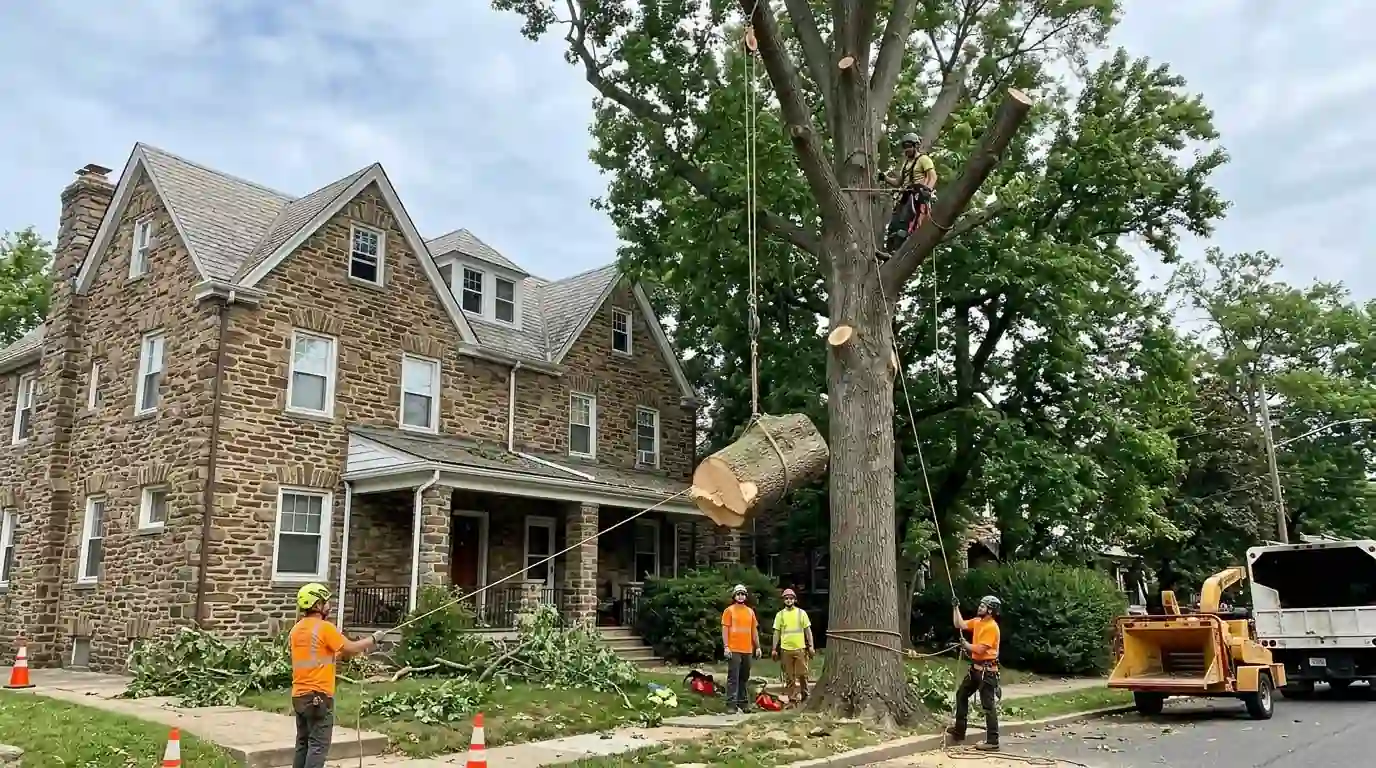
The scale changes everything. A single limb on a mature oak can weigh as much as a small car, so it can't be cut and dropped near a house. It gets rigged through a high anchor point, cut, and lowered under friction control. The trunk comes down in rounds heavy enough to crack a sidewalk if dropped.
Big trees also tend to be old, and old trees hide problems: a hollow trunk, a decayed root flare, a cavity behind a burl. Those change how a climber can tie in. If the tree is mostly dead, see removing a dead tree; if it is in a fenced rowhome yard, tight-access removal covers it. When a build is coming and some trees should stay, protecting the keepers during construction starts before the first machine arrives.
What large tree removal costs
Big trees sit at the top of every published range. These five things decide where in that range a tree lands.
- 01
Height and crown spread. A 90-foot poplar is a long climb; a wide oak is many separate rigs.
- 02
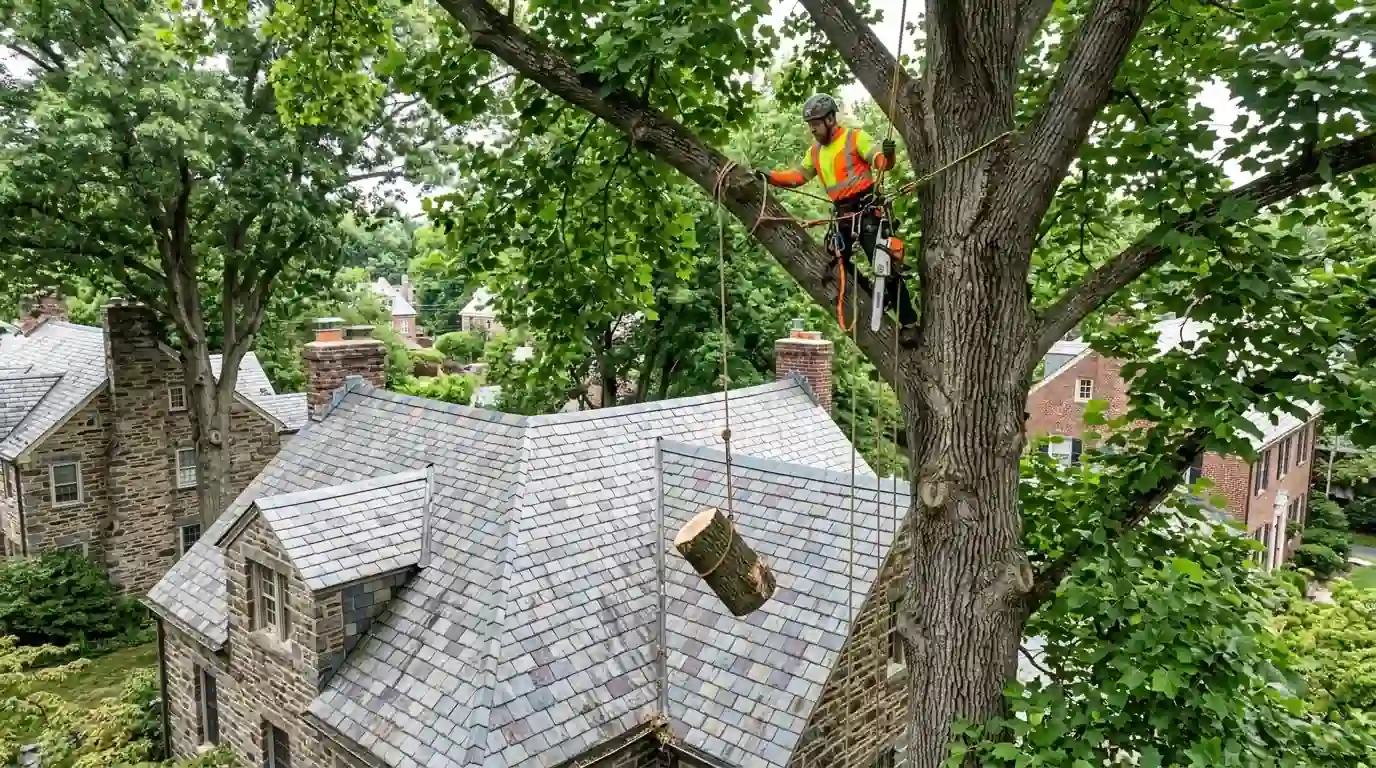
Targets under the canopy. Roofs, garages and wires mean every limb is lowered.
- 03
Method. A crane costs more per day but can shorten a job by days.
- 04
Hidden decay. A hollow trunk changes tie-in points and may need a lift instead of a climb.
- 05
Wood volume. Several truckloads of logs cost more to haul than a yard tree.
| Job | Published range | Source |
|---|---|---|
| Large tree removal, 60 to 80 ft | $800 to $1,500 | HomeAdvisor, 2026 |
| Very large tree removal, over 80 ft | $1,000 to $2,000 | HomeAdvisor, 2026 |
| Crane for tree removal | $250 to $600 per day | HomeAdvisor, 2026 |
Planning numbers from published surveys, not our prices. We price after seeing the tree.
Climb it, use a lift, or bring a crane?
| Method | Fits when | Tradeoff |
|---|---|---|
| Climbing and rigging | The tree is sound and the yard is tight | Slower, but needs no truck access to the tree |
| Bucket lift | A truck can reach the tree on firm ground | Fast and safe on decayed trees, useless behind houses |
| Crane | Big pieces must go over a house or the tree is unsafe to climb | Highest day rate and a street permit, but often the shortest job |
Oak and tulip poplar removal
Oaks are heavy, dense and spread wide, with long horizontal limbs that each need their own rigging. Tulip poplars go straight up, often past 90 feet, with most of their crown at the top. On a poplar the climb is long and the top piece is the hard one; on an oak the work is spread across the whole crown. Both fill several truckloads.
Sycamore and London plane removal
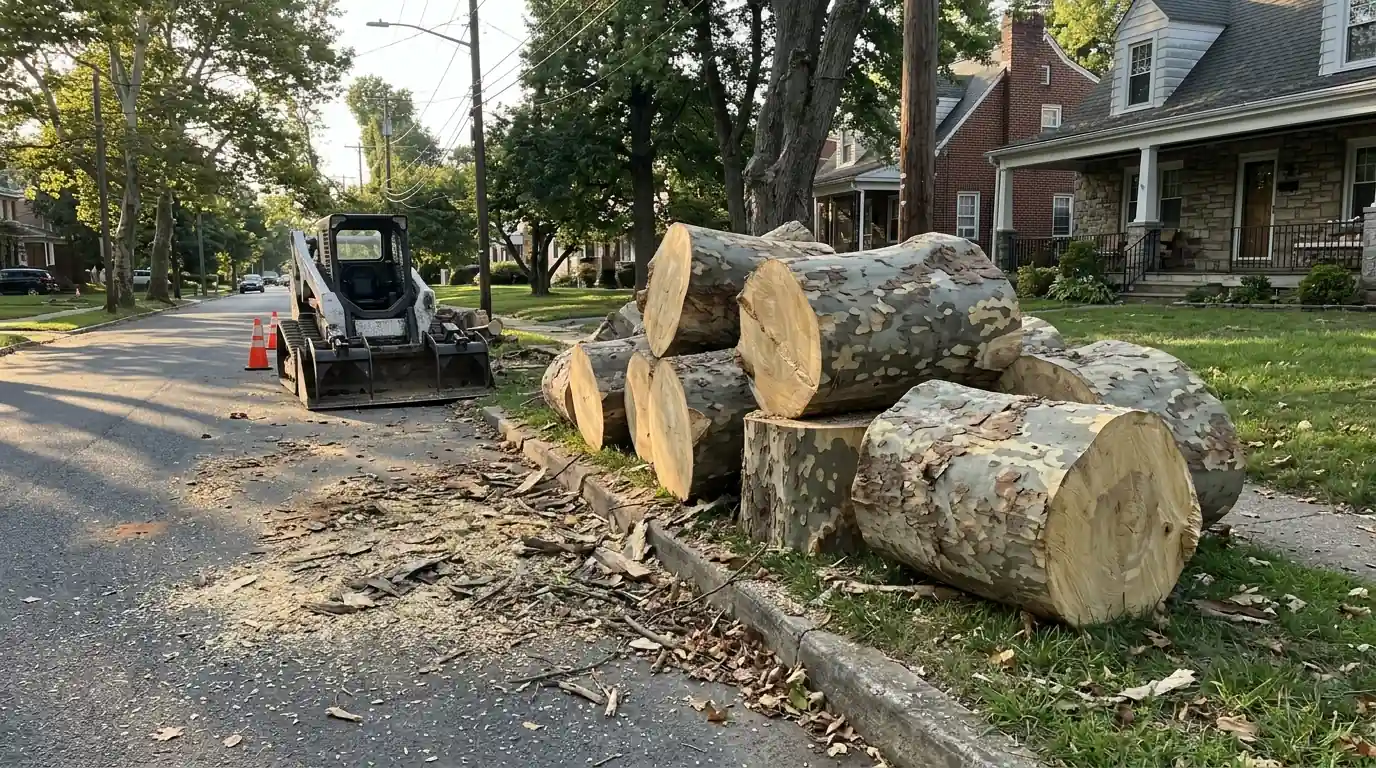
Sycamores and London planes grow huge along streets and creeks, with mottled bark and limbs that reach far out. Their wood is tough and stringy, so limbs often hang rather than break clean. A plane growing in the sidewalk strip is a street tree, which means a Parks and Recreation permit before removal; our street tree removal page explains that step.
Silver maple removal
Silver maples grow fast and big, often with several main stems from low on the trunk. Those narrow unions crack, and the wood is weak, so storms break them apart. When we take one down, we rig each stem separately and watch for included bark that can split as weight comes off. Many silver maples near houses come down for exactly that reason.
What a large tree removal includes
- Inspection of the trunk, root flare and crown for decay
- Method chosen for the site and explained to you
- Street permit or utility make-safe where needed
- High-point rigging for every limb near a target
- Trunk taken in lowered or picked rounds
- Brush chipped on site
- Logs hauled or left as firewood
- Lawn protected where heavy wood crosses
- Stump grinding if it is part of the job
Where Philadelphia's biggest trees grow, and the slope rules there
Big trees cluster where the canopy is heaviest. A 2021 Inquirer analysis found Chestnut Hill at about 60 percent canopy, with Mount Airy, Roxborough and the Wissahickon area at 40 percent or more. Many of those leafy streets are steep, too. Since 2012 the city code has prohibited earth disturbance on slopes of 25 percent or more, mostly in Northwest Philadelphia, and lesser steep slopes need Planning Commission approval, which is worth knowing before anyone grinds a stump or digs roots on a hillside lot.
How a big tree comes down
Size it up
Height, spread, decay and what sits underneath.
Pick the method
Climb, lift or crane, based on access and targets.
Set a high anchor
A rigging point high in sound wood carries every lowered piece.
Strip the crown
Limbs come off one at a time, each lowered.
Take the trunk in rounds
Top-down sections lowered or picked.
Process the wood
Brush chipped, logs bucked and loaded.
Stump and cleanup
Stump ground if you want it, yard cleaned.
Big tree questions
Pricing guides usually start large at around 60 feet. In practice, a tree is large when its limbs are too heavy to drop near anything that matters.
No. Most come down by climbing and rigging. A crane earns its cost when the tree is decayed, leans over a house, or sits where wood must go over a roof.
Often one long day, sometimes two for a wide oak with targets everywhere. A crane can turn a two-day climb into a few hours of picks.
Often. If the concern is limbs over the house, a crown reduction or targeted pruning may solve it for far less than removal.
We haul it, or leave rounds for firewood. Large oak trunks are heavy and slow to split, so most people keep only some.
Other removal work
Crane Tree Removal
Big picks lifted over roofs when there is no safe way to lower the wood by rope.
Dead Tree Removal
Brittle dead wood taken down from a lift or by rope instead of climbing it.
Tree Removal
Sectional takedowns sized to the yard, with the wood, brush and cleanup handled.
Crown Reduction
Shortening a crown back to healthy side branches instead of topping it.
Got a giant to deal with?
Call and tell us about it. We'll come look and explain which method fits.