Quick answer
Spotted lanternfly treatment means protecting the trees the insect feeds on hardest and removing the tree of heaven it favors. Trunk injection is the usual way to shield a valued tree, and HomeAdvisor puts general tree injection at $50 to $200 per tree. Healthy, established trees usually survive the feeding; the sticky residue and black mold are often the bigger nuisance.
What lanternflies do to a tree
Nymphs and adults pierce bark and young stems to drink sap. One insect does little, but hundreds on a single maple stress it, and their sugary droppings coat leaves, decks and cars below. Sooty mold grows on that film and shades the leaves under it, which is how heavy infestations wear plants down.
Treatment works on two fronts. Valued trees near the house can get a trunk injection timed for the feeding season. The host trees come out, and because a cut tree of heaven answers with a flush of root sprouts, that job needs tree of heaven removal done with the roots in mind. Our explainer on why cutting the host is not enough covers the sprouting problem.
What a lanternfly visit includes
- A walk of the yard to see which trees the insects crowd
- Tree of heaven found, including young ones in fence lines
- Valued trees picked for protection by species and size
- Trunk injection timed for the feeding season
- Egg masses scraped off reachable bark in winter
- Host trees cut with a plan for root sprouts
- Brush chipped and wood hauled away
- Honeydew and mold damage noted on plants below
- A note of what to watch for next season
Protecting maples and ornamentals
Red and silver maples, birches, black walnut and willow take heavy feeding late in the season, and a Japanese maple over the patio can end up coated. A trunk injection carries a systemic treatment into the sap, so insects feeding on that tree take it up. We time it for when adults move onto those species. The general injection range HomeAdvisor publishes is $50 to $200 per tree, scaling with trunk size.
Egg mass scraping
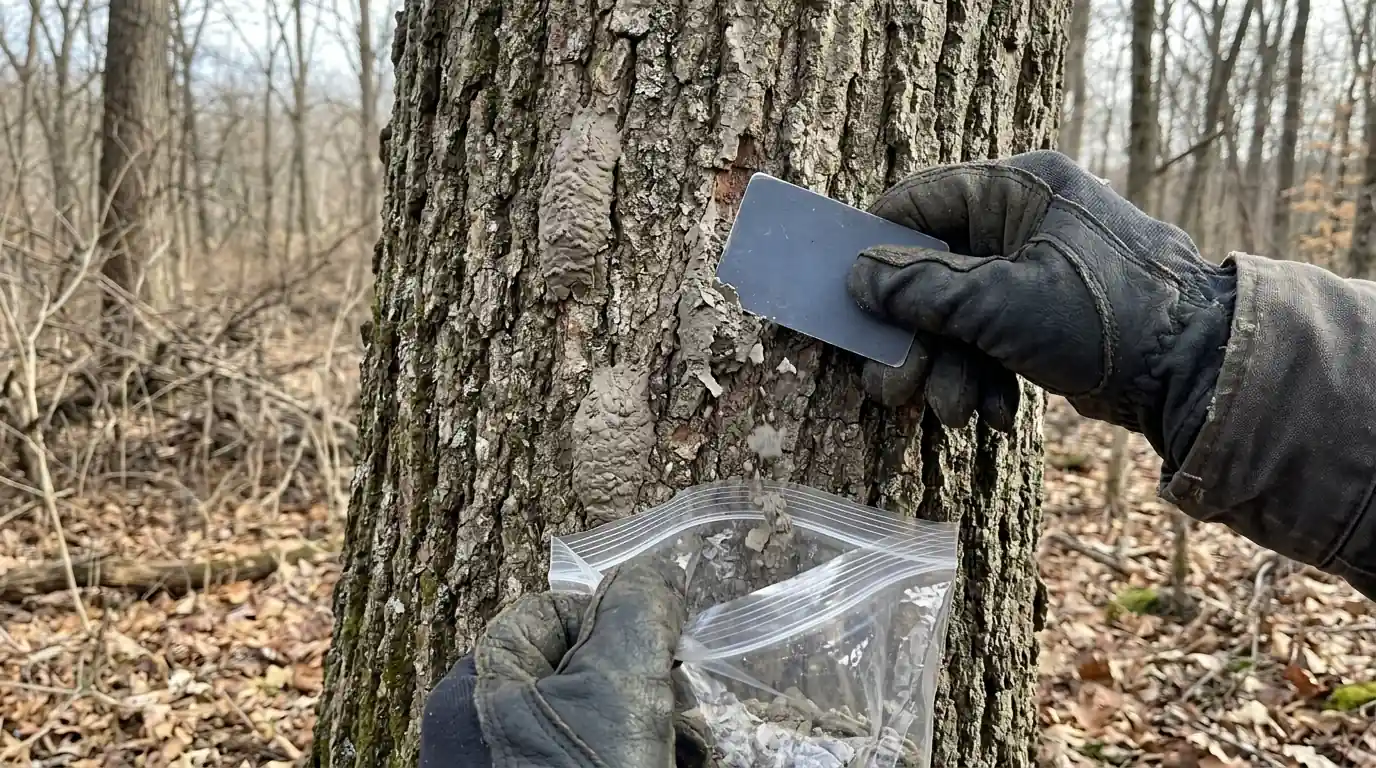
Each egg mass holds dozens of eggs under a gray, mud-like coating, laid in fall on bark, stone, fences and trailers. From fall through spring they can be scraped into a bag of rubbing alcohol or hand sanitizer to kill them. We scrape what we can reach on trunks and limbs during winter work. It cuts local numbers, though new adults still fly in from untreated lots nearby.
Removing host trees
Tree of heaven is the lanternfly's favorite food, and in many yards it is a weed tree nobody planted. Taking it out removes the main magnet, as long as the roots are planned for or it returns as a thicket. Small ones under 30 feet fall in HomeAdvisor's $150 to $450 range for small tree removal. Bigger ones crowding a garage are a regular sectional takedown.
Signs lanternflies are feeding on your trees
- A sticky, shiny film below the canopy
Honeydew coating leaves, patio furniture and windshields.
- Black mold on leaves and bark
Sooty growth spreading over that film by midsummer.
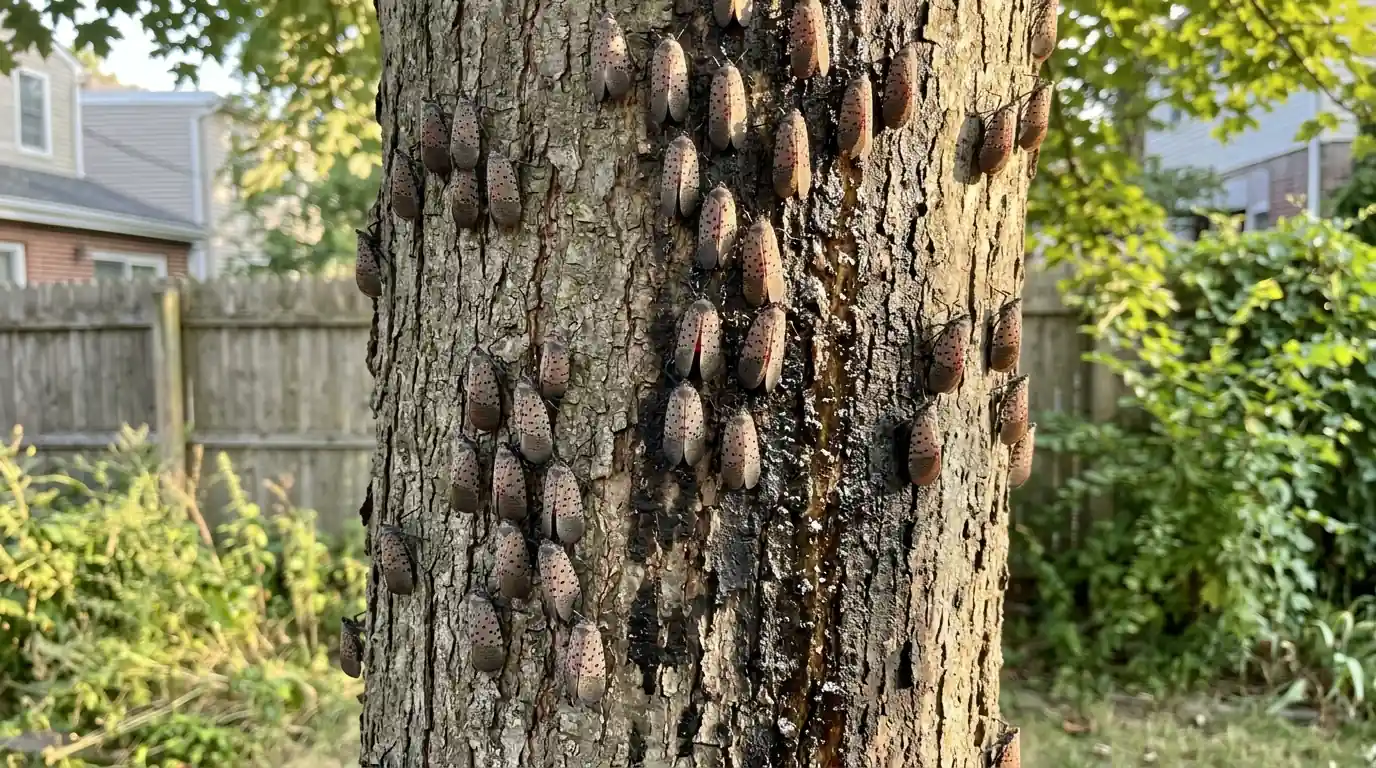
- Insects lined up on the trunk
Gray spotted adults or red and black nymphs in rows.
- Weeping streaks on the bark
Wet lines running down from feeding wounds.
- Putty-like smears in winter
Egg masses like dried gray mud, often on the shady side.
- Wasps crowding one tree
Stinging insects drawn to honeydew on a heavily fed-on tree.
Quarantines on both sides of the river
Philadelphia has been inside Pennsylvania's spotted lanternfly quarantine since 2017, and tree of heaven, the insect's favorite host, has spread across the city as a weed tree. The droppings from its sap feeding grow a mold that can eventually kill plants. Across the river, New Jersey's quarantine covered eight counties by August 2020, Camden, Gloucester and Mercer among them, with treatment focused on tree of heaven even though the insect feeds on about 70 kinds of plants.
How we handle a lanternfly problem
Find the hot trees
Which trees the insects crowd and where honeydew falls.
Spot the hosts
Tree of heaven located, from mature trees to fence-line sprouts.
Pick what to protect
Valued trees chosen by species, size and place in the yard.
Time the injection
Treatment given ahead of the late-summer feeding peak.
Take out hosts
Tree of heaven cut down with resprouting planned for.
Scrape egg masses
Reachable masses removed in the dormant season.
Check next summer
Feeding pressure and host regrowth looked at again.
What lanternfly treatment costs
Costs split between protecting the trees you keep and removing the ones that feed the insect. Five things set the total.
- 01
Trees protected. Each injected tree is priced on its own, mostly by trunk size.
- 02
Host trees to remove. One tree of heaven is a short job; a fence line full of them is a day.
- 03
Sprout follow-up. Tree of heaven roots push suckers for a season or more after cutting.
- 04
Access for the wood. Hosts growing against garages and fences come down in small pieces.
- 05
Egg mass scraping. Scraping adds little when it rides along with winter pruning.
| Job | Published range | Source |
|---|---|---|
| Tree injection | $50 to $200 per tree | HomeAdvisor, 2026 |
| Small tree removal, up to 30 ft | $150 to $450 | HomeAdvisor, 2026 |
Planning numbers from published surveys, not our prices. We price after seeing the tree.
Spotted lanternfly questions
A healthy, established maple usually survives the feeding, though heavy years stress it. Young, stressed or newly planted trees are at more risk, along with grapevines.
They catch climbing nymphs, but open bands also trap birds and small animals. If you use one, a circle trap or a band caged in wire mesh is far safer for wildlife.
Adults peak from late summer into fall, when swarms and honeydew are heaviest. Nymphs appear in late spring, and egg masses are laid from fall onward.
Removing them takes away the favorite host, but cut stumps sprout hard. Plan for the root sprouts at the same time, or you end up with more trees than before.
Yes. Honeydew rinses off with water and mild soap if you get to it before the black mold sets in. Moldy surfaces take more scrubbing.
Related tree health work
Tree of Heaven Removal
Cut, stump-treated and followed up so the root sprouts do not come back.
Emerald Ash Borer Treatment
Trunk injections that protect healthy ash worth saving from the borer.
Deep Root Fertilization
Feeding and loosening compacted root zones around stressed city and suburban trees.
Tree Inspection & Risk Assessment
A walk-around look at decay, cracks, lean and roots, with a straight answer on what needs doing.
Lanternflies on your trees again?
Call and tell us what you are seeing. We will walk the yard, find the hosts, and tell you what protection makes sense.