Quick answer
Young tree pruning means removing a few branches every couple of years so the tree grows one dominant trunk and well-spaced, firmly attached limbs. LawnStarter's published trimming range for trees under 30 feet is $85 to $415, and the cuts are small, so a visit is short. Early cuts head off structural faults that cost real money decades later.
Why the first ten years decide the next fifty
Many of the big-tree failures we clean up after storms started as a young-tree problem: two trunks forming a tight V, a limb nearly as thick as the trunk it grows from, or a cluster of branches leaving one spot. Each was a pencil-thin cut once.
Structural pruning picks a leader, slows the stems competing with it, and spaces the main limbs along the trunk. We take little each visit, because a young tree needs its leaves to build roots. Mature trees get different work, covered under shade tree trimming, and a tree you have not planted yet should start right with proper planting. A young apple or pear needs its scaffold set differently; see training backyard fruit trees.
What a young tree pruning visit includes
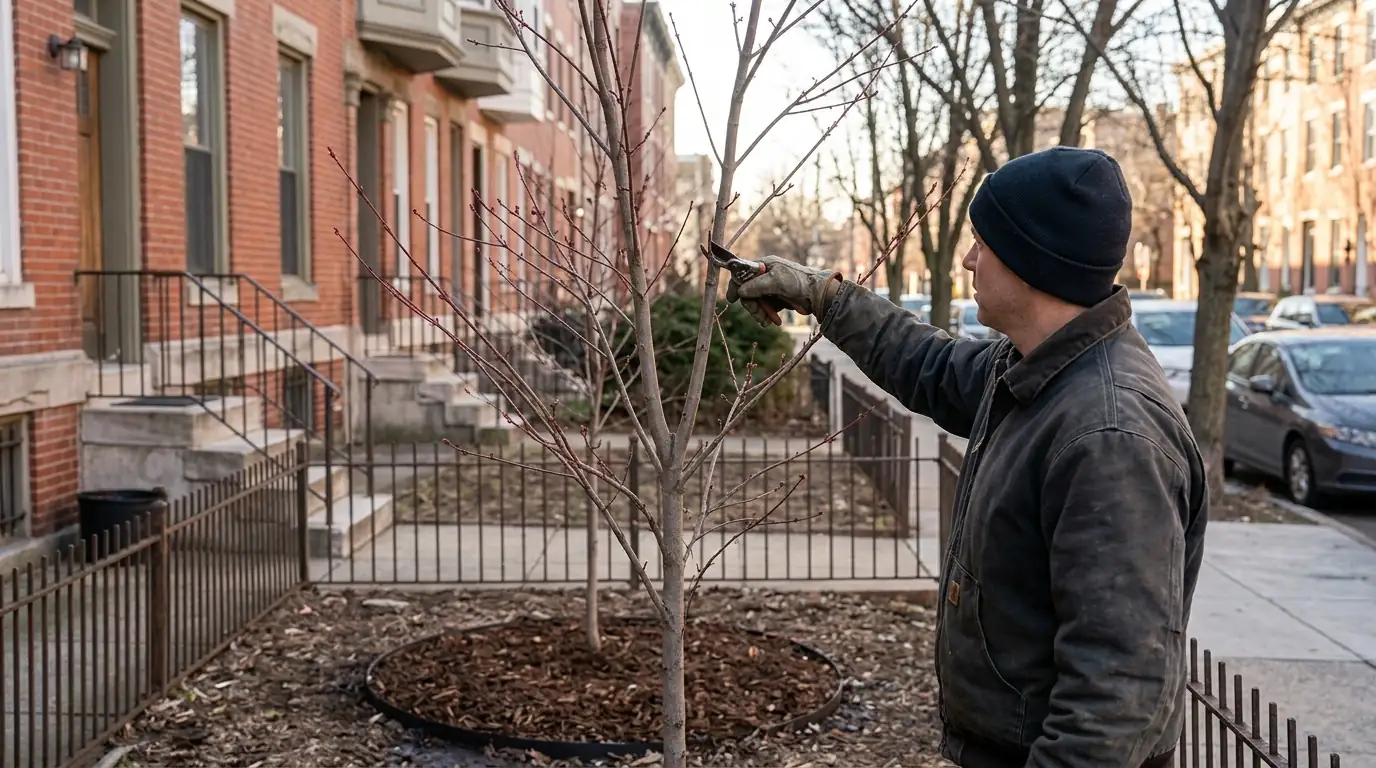
- A look at the trunk, leader and every main branch
- One leader chosen and its rivals shortened
- Tight, bark-pinched forks corrected while small
- Main limbs spaced along the trunk
- Crossing and rubbing branches removed
- Broken, dead and diseased twigs cut out
- Stakes and ties loosened or taken off
- Mulch pulled back off the trunk flare
- A note on when the next visit makes sense
Single-leader training
Most shade trees here, oaks, maples, lindens and honeylocust, grow strongest with one central trunk. When a second stem starts racing the first, you see a fork in the top third of the tree. We keep the straighter, stronger one and shorten the rival by a third to a half so it slows down and becomes a side limb. Cutting it off outright can take too much leaf at once.
Fixing narrow branch unions
A branch meeting the trunk at a tight angle traps bark in the crotch instead of building solid wood. From the ground it looks like a seam or pinched line running down from the fork. On a young tree the fix is simple: remove that branch or cut it back hard while it is small. Left alone, it becomes the split that needs cables and rods decades later.
Pruning newly planted trees
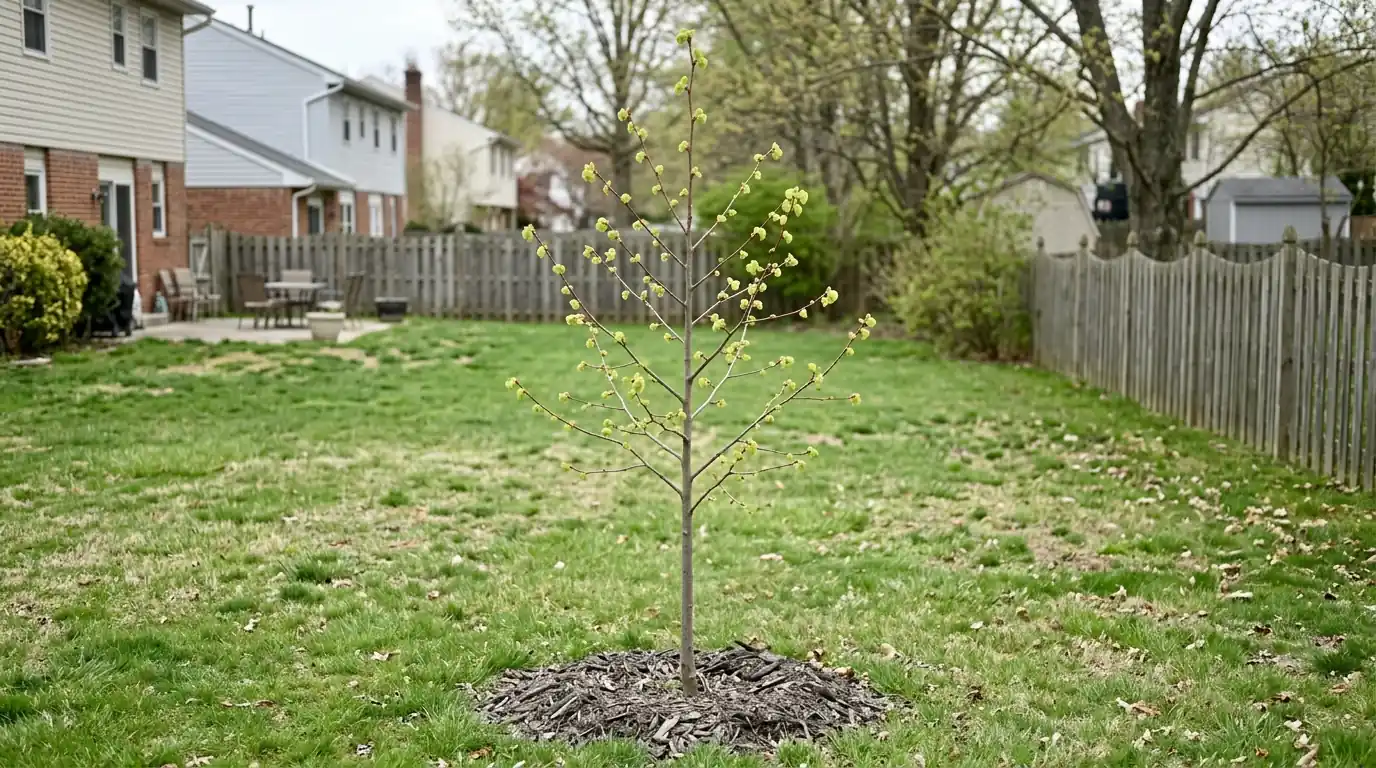
In its first year a new tree is busy growing roots, so we cut almost nothing: broken twigs, a rubbing branch, an obvious second leader. Heavy pruning at planting slows establishment. Light structural work starts in the second or third season, usually in late winter when the branch layout is easy to read. Stakes and ties left on too long girdle the trunk, so we check those every time.
Young trees and the city's canopy goals
TreePhilly, the Parks and Recreation program run with the Fairmount Park Conservancy, has given residents free yard trees since 2012 and passed 25,000 by fall 2020. Residents plant them on their own property, so shaping them falls to the owner. The stakes are real: a 2018 assessment put city tree cover near 20 percent, down 6 percent from 2008, and the 2023 Philly Tree Plan aims for 30 percent in every neighborhood within 30 years, with priority areas in South, West, Southwest, North and Northeast Philadelphia.
How we train a young tree
Step back and look
We view the tree from several sides to read its natural shape.
Pick the leader
The straightest, strongest stem stays on top.
Slow the rivals
Competing stems are shortened, not always removed.
Fix weak forks
Tight, bark-pinched unions are cut while the wood is small.
Space the limbs
Main branches are thinned so they spread up the trunk.
Check the base
Stakes, ties and mulch looked at by the trunk.
Plan the follow-up
We tell you roughly when the next visit makes sense.
Pruning a young tree yourself, or calling us
This is one pruning job plenty of homeowners handle well, once they know which branch to cut.
| Doing it yourself | Having us do it | |
|---|---|---|
| Choosing the leader | Easy to cut the wrong stem or leave two competing. | We pick the leader for the tree's long-term shape. |
| How much to take | Over-pruning a young tree can stunt it for years. | A small, measured share each visit. |
| Cut placement | Flush cuts and stubs both slow wound closure. | Cuts just outside the branch collar. |
| Reach | Fine from the ground for the first few years. | Pole tools or a short climb once the top is out of reach. |
What young tree pruning costs
Young trees fall in the smallest trimming bracket the surveys publish. Five things set where a visit lands.
- 01
Number of trees. Pruning several young trees on one visit spreads the setup across all of them.
- 02
Height. Ground work is quick; a top that needs a pole saw or short climb takes longer.
- 03
How overdue it is. A tree left alone for eight years needs more cuts, sometimes spread over two visits.
- 04
Species. Fast growers with many competing stems need more decisions than tidy growers.
- 05
Cleanup. Small brush chips or bags quickly, which keeps this among the shorter jobs.
| Job | Published range | Source |
|---|---|---|
| Tree trimming, per tree | $430 to $640 | LawnStarter, 2026 |
Planning numbers from published surveys, not our prices. We price after seeing the tree.
Young tree pruning questions
Lightly in the first year, only broken or rubbing twigs. Real structural pruning starts in the second or third growing season, once the roots have settled.
Every two to three years for the first ten to fifteen years. Each visit is small, and the gap gives the tree time to respond.
Late winter, while the tree is dormant, is usual because the branch layout is easy to see. Light corrective cuts can be made in summer too.
Yes, it is your tree. Keep cuts small, use clean sharp pruners, and never strip off a large share of the leaves in one year.
Usually not. Structure can still be corrected at that size, just over two or three visits instead of one, with a pole saw or short climb.
More pruning and planting work
Tree Trimming
Cleaning, thinning and shaping that keeps a shade tree healthy and out of the way.
Fruit Tree Pruning
Late-winter pruning that opens backyard fruit trees to light and air.
Ornamental Tree Pruning
Careful hand pruning for Japanese maples, dogwoods and flowering cherries.
Tree Planting
Planting replacement trees, including the replacements some towns require.
Have a young tree worth getting right?
Call and tell us what you planted and when. We will look at its shape, explain the cuts, and price the visit.