Quick answer
Cabling ties weak leaders together with steel cable high in the crown, and bracing runs threaded rods through a split or weak union lower down. HomeAdvisor lists cabling at $200 to $400 nationally, about $175 for small trees and $400 or more for medium or large ones. It supports a sound tree with one weak point; it cannot save a rotten one.
How cables and rods hold a tree together
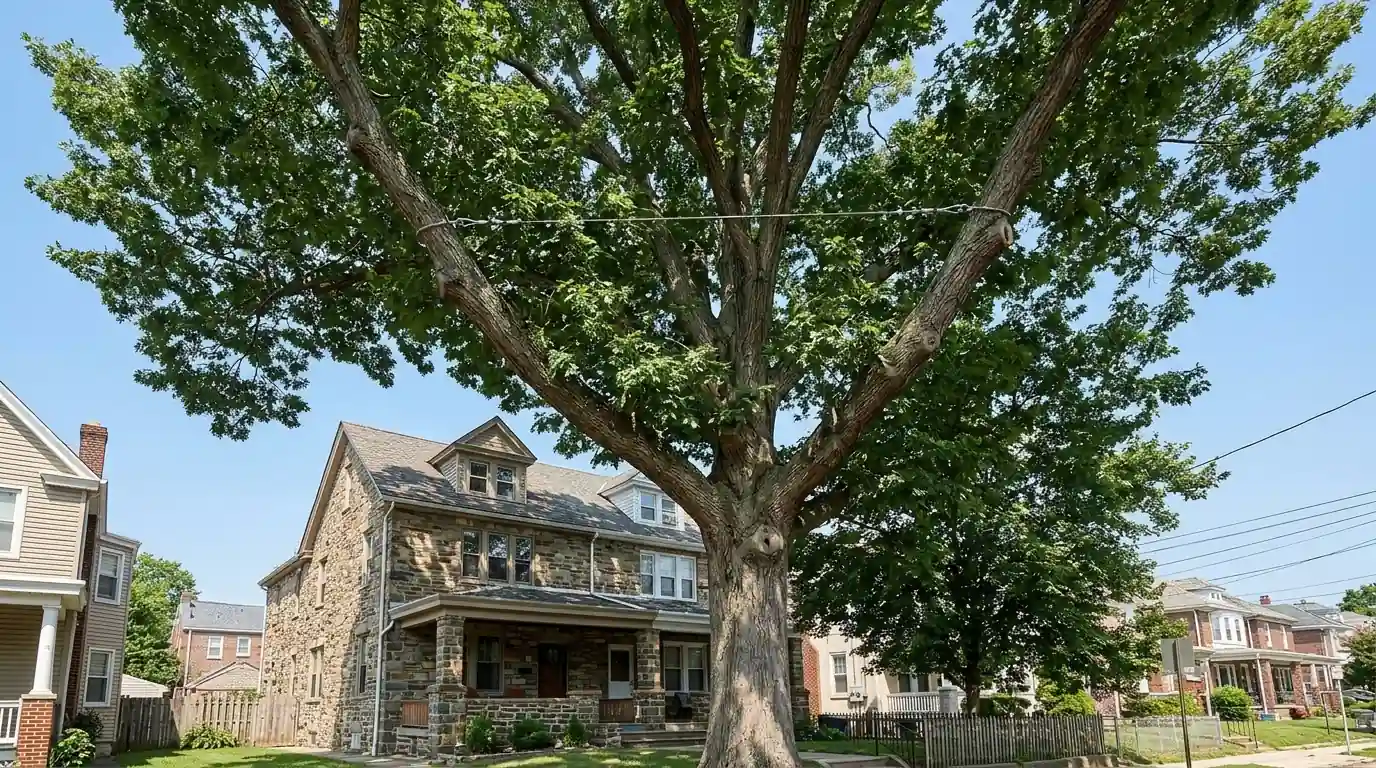
Two leaders of similar size growing from one point often trap bark between them as they thicken. That included bark is a weak seam, and under wind or ice the stems lever against each other until one tears away, sometimes taking half the tree. A cable set about two-thirds of the way up the leaders limits how far they can spread.
Bracing works lower, where a union has cracked or is about to. Rods through both stems hold it closed. Hardware is often paired with a crown reduction to take weight off the leader ends. If decay has already hollowed the fork, support is money wasted, and a tree inspection will show which side of that line the tree is on.
Cabling split leaders
Two or three leaders splaying from one fork, with a crease of bark between them, is the classic cabling job. We set the cable roughly two-thirds of the way up the leaders, through-bolted or on lag eyes depending on stem size, with just enough slack for normal sway. HomeAdvisor's national range of $200 to $400 covers a typical single cable on a medium tree.
Bracing weak unions
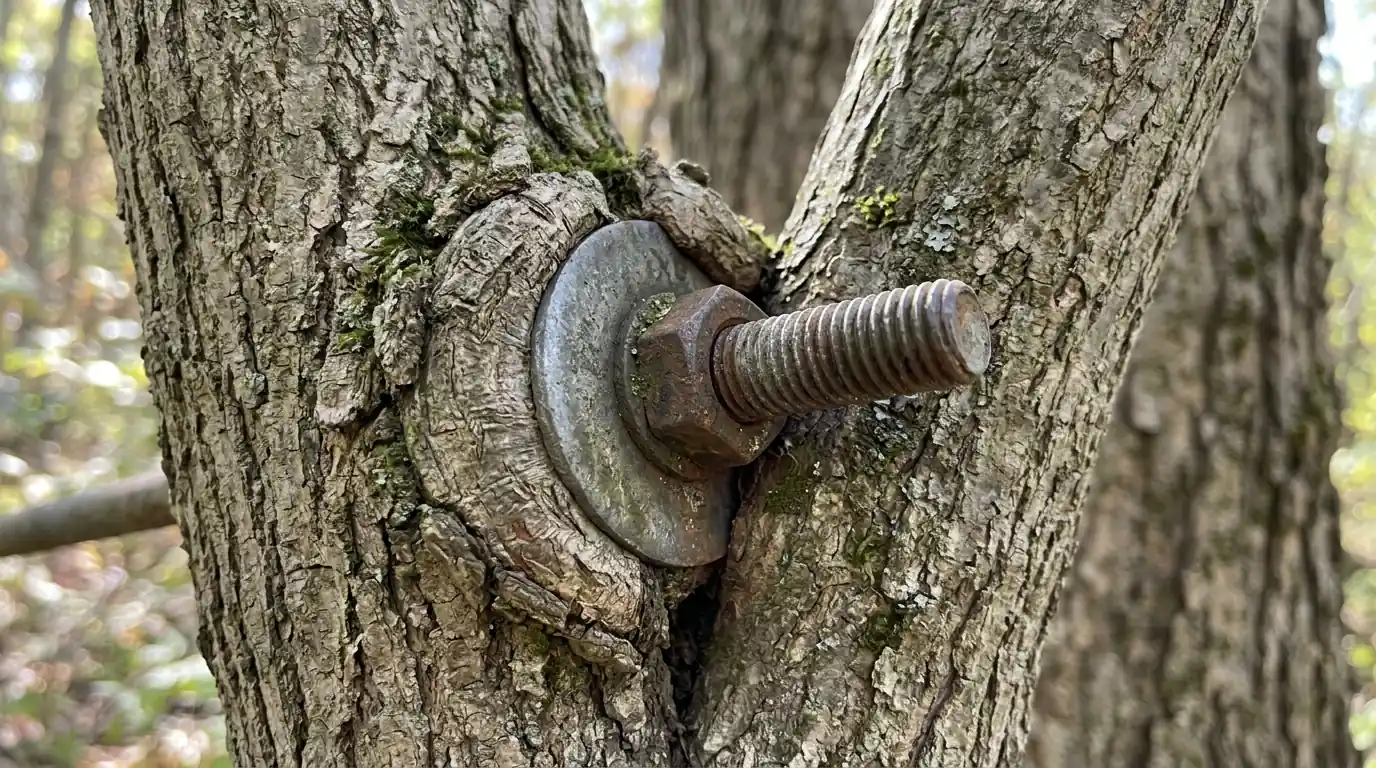
Once a fork has cracked, a cable alone is not enough. Bracing rods go straight through the union, sometimes two or three staggered, with wide washers the wood can grow around. We usually add a cable above so the crown's leverage stops prying the crack open. Rods are permanent, and over the years the tree walls them in.
Cable inspections
Hardware put in ten or fifteen years ago may have gone slack, frayed or been swallowed by bark. A check looks at cable tension, the anchors and the union they protect, which may have changed since. We tighten, replace or remove what we find. A yearly look, plus one after any major windstorm, is a sensible rhythm for a cabled tree.
Signs a fork may need support
- A tight V where two stems meet
Bark folded inward between leaders of similar thickness.
- A seam running down from the fork
A dark line or ridge below the union where a split has begun.
- Leaders swaying apart in wind
Stems moving separately instead of as one crown.
- An old cable gone slack
Sagging wire, or hardware the bark has started swallowing.
- Ooze or soft wood at the union
Wet staining where the stems join.
- A long limb stretched over the house
Heavy end weight with nothing above to share it.
Recent storms that tested weak forks
The last few years showed what wind does to weak unions around Philadelphia. Ida's remnants in September 2021 produced seven tornadoes in the region, including an EF-2 that ran from Fort Washington into Horsham and an EF-1 that crossed the Delaware into Bristol. In July 2026, severe storms with microbursts damaged trees across Philadelphia and Lower Merion, and the City ran its recovery under a disaster emergency declaration, with tree recovery support sent to West and South Philadelphia. Storms like these load every weak fork at once.
How a cabling job is installed
Inspect the union
Fork checked for included bark, cracks and decay.
Plan the hardware
Cable height, anchor type and rod count set by stem size.
Lighten the ends
Selective reduction takes weight off the leaders being tied.
Climb and drill
Anchor holes drilled at the planned height on each leader.
Set the cable
Cable run and tensioned so the stems move together.
Rod the crack
Through-rods with washers and nuts across any split.
Log the hardware
Positions noted so the next check knows what is up there.
Cable it, shorten it, or take it down?
| Condition of the fork | Usually cable or brace | Usually something else |
|---|---|---|
| Narrow V-fork, no crack yet | Cable between the leaders, often with some end-weight reduction | On a young tree, remove one leader early |
| Crack starting at the union | Through-rods across the crack plus a cable above | A crack running into the trunk base means taking the tree down |
| Long limb over the roof | A cable to a stronger stem if the limb is sound | Shortening the limb is often simpler |
| Decay or cavity at the fork | Rarely, since hardware needs sound wood to grip | Removal, or a reduction to lower the load |
What tree cabling costs
Published figures are per cable on an average tree. Five things push a job above or below them.
- 01
Tree size. A small ornamental may take one light cable; a large oak can need several heavy ones.
- 02
Number of leaders. Three or four leaders tied in a triangle take more hardware than a pair.
- 03
Rods as well. Bracing a cracked union adds drilling and threaded rod.
- 04
Pruning alongside. Reducing end weight adds climbing time but makes the support last.
- 05
Reaching the crown. A crown reachable by lift goes faster than one climbed over a roof.
| Job | Published range | Source |
|---|---|---|
| Tree cabling | $200 to $400 | HomeAdvisor, 2026 |
Planning numbers from published surveys, not our prices. We price after seeing the tree.
Cabling and bracing questions
Steel cable can last decades if it is checked and adjusted, but the tree grows around it. A slack or swallowed cable can fail exactly when it is needed.
A clean hole of the right size seals over, and the tree walls it in. That is a small wound next to losing half the crown in a split.
Sometimes, if the split is fresh, the wood sound, and the stems come back without tearing further. Old splits that have rotted are past bracing.
No, and it should not. A cable allows normal sway and only takes load when the leaders spread too far, which keeps the wood building strength.
Yes. Shortening cabled leaders every several years keeps the load on the hardware down and the crown balanced.
Other ways to keep a tree standing
Tree Inspection & Risk Assessment
A walk-around look at decay, cracks, lean and roots, with a straight answer on what needs doing.
Deep Root Fertilization
Feeding and loosening compacted root zones around stressed city and suburban trees.
Crown Reduction
Shortening a crown back to healthy side branches instead of topping it.
Broken & Hanging Limb Removal
Snapped branches hung up in the crown, brought down before they drop on their own.
Got a fork you are worried about?
Call and tell us about the tree. We will look at the union and tell you honestly whether hardware will help or it is past saving.