Quick answer
Ornamental trees are pruned by hand, a few selective thinning cuts at a time, never sheared into balls. Timing follows the tree: Japanese maples in late winter or midsummer, spring bloomers like dogwood and cherry soon after flowering. LawnStarter's published range for trimming a tree under 30 feet is $85 to $415, the bracket most ornamentals fall into.
Why ornamental pruning is slower work
Ornamental trees are grown for their form: the layered tiers of a Japanese maple, the flat sprays of a dogwood, the arching spread of a weeping cherry. That form is easy to ruin with hedge shears or a few big cuts, and small trees grow back slowly.
So this is close work, often from a ladder or standing inside the canopy. We remove dead and crossing twigs, thin crowded interior shoots so the branch pattern shows, and shorten a stray limb to a side shoot rather than chopping it. Big shade trees get routine crown trimming instead, and a young ornamental gains a lot from early structural cuts. Backyard apples and pears follow their own rules, set out in pruning apple, pear and peach trees.
What ornamental pruning costs
Ornamentals fall in the small-tree trimming bracket. Five things move a visit inside it.
- 01
How overgrown it is. A yearly tidy is short; years of interior shoots take patient thinning.
- 02
Size and spread. A wide old Japanese maple takes longer than a young redbud of the same height.
- 03
Setting. Trees ringed by beds, ponds or stonework need careful ladder placement and cleanup.
- 04
Disease cuts. Removing black knot or canker adds slower, cleaner work.
- 05
Number of trees. Several ornamentals on one visit share a single setup.
| Job | Published range | Source |
|---|---|---|
| Tree trimming, per tree | $430 to $640 | LawnStarter, 2026 |
Planning numbers from published surveys, not our prices. We price after seeing the tree.
Thin it, shear it, or cut it back hard?
These are the three things people do to an ornamental tree. Only one keeps it looking like itself.
| Approach | What it does | When it fits |
|---|---|---|
| Hand thinning | Removes whole shoots back to a fork, keeping the natural shape and layering | Routine care for maples, dogwoods, redbuds and cherries |
| Shearing | Clips every tip to a surface, causing dense twiggy regrowth and fewer flowers | Formal hedges, not specimen trees |
| Hard reduction | Shortens main limbs to pull a tree back from a walk or window | A tree that has outgrown its spot, spread over two or three seasons |
A tree that has outgrown its space for good may be better replaced, and replanting the spot with something that fits is sometimes the kinder fix.
Pruning an ornamental yourself, or calling us
| Doing it yourself | Having us do it | |
|---|---|---|
| Tools | Hedge shears are fast but leave stubs and a puffball shape. | Hand pruners and a small saw, one cut at a time. |
| Timing | A late-summer cut on a dogwood removes next year's flower buds. | Each species pruned in its own window. |
| Cut placement | Cuts mid-branch sprout clusters of new shoots. | Thinning cuts back to a fork or the collar. |
| Disease | Black knot and canker spread on unclean pruners. | Infected wood cut out well below the damage, tools cleaned. |
Japanese maple pruning
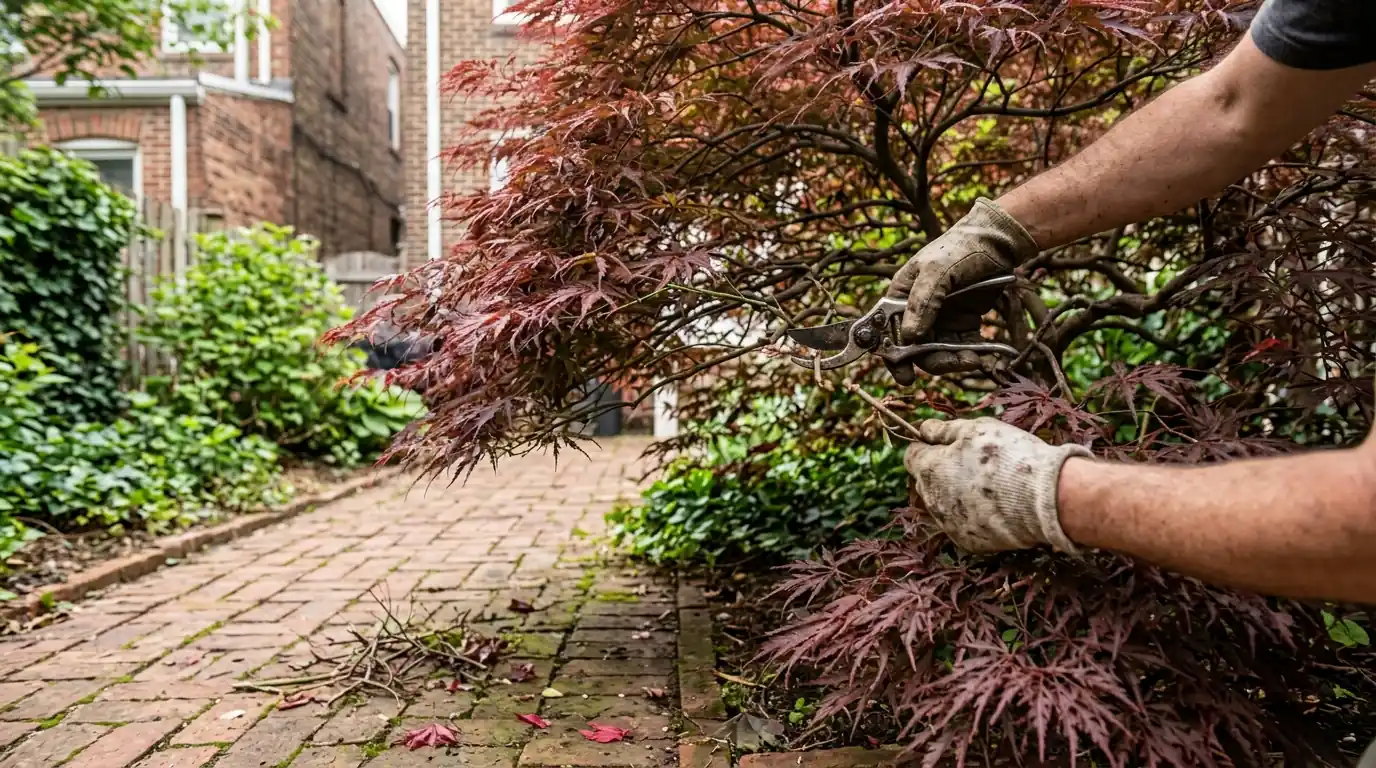
Japanese maples are pruned for their layers. Over time the interior fills with thin, crossing shoots and the tiers vanish into a solid dome. We thin from the inside out, removing dead twigs, inward shoots and stems rubbing each other, until you can see the branch structure through the leaves. Heavy cuts wait out the spring sap flow; late winter or midsummer suits the work, and the result should look untouched from the street.
Dogwood and redbud pruning
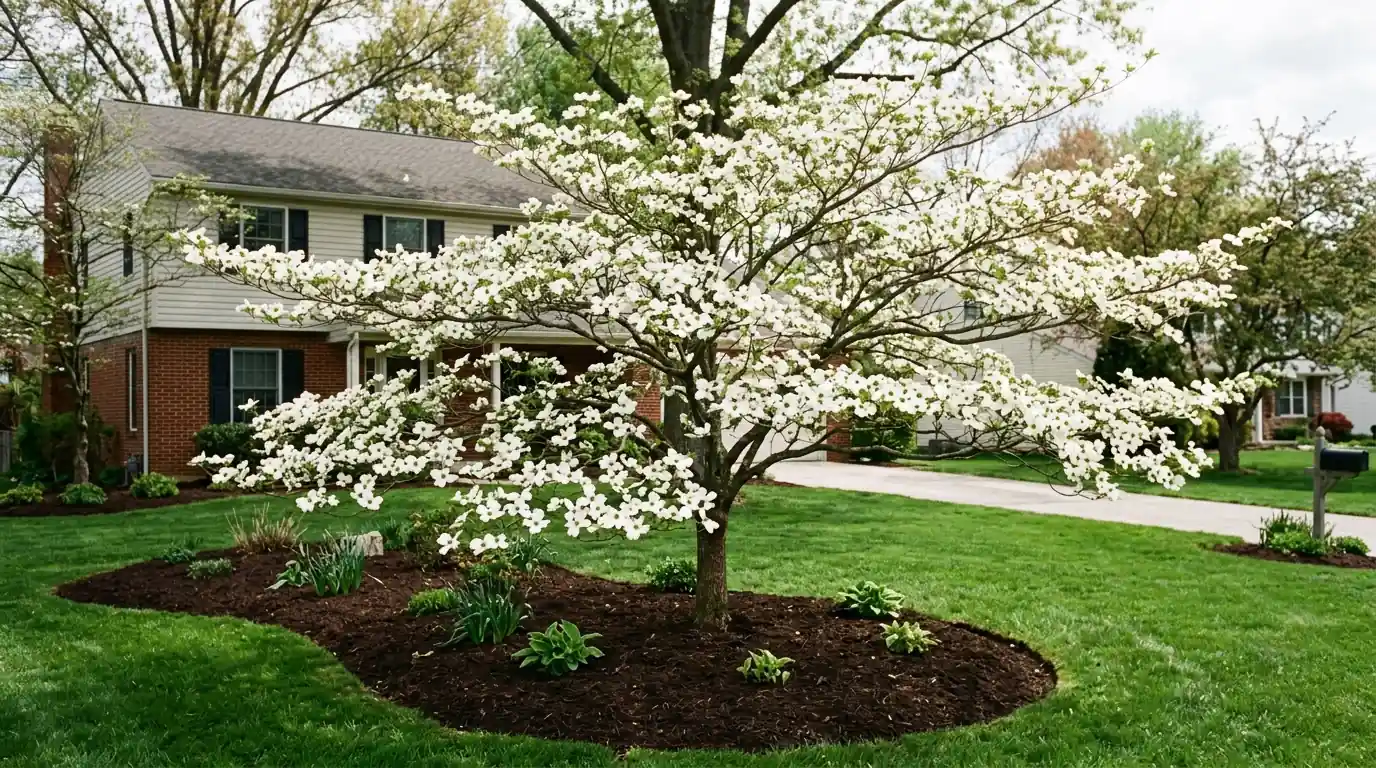
Dogwoods and redbuds set next spring's flower buds over summer, so cutting in late summer or fall removes the show. We prune soon after they finish blooming, or in late winter for dead and damaged wood. Both are prone to tight, weak forks and to cankers that kill branches back. Dead limbs are cut into clean wood and wounds kept small, since fresh cuts on a stressed dogwood can draw borers in late spring and summer.
Flowering cherry pruning
Flowering cherries, Kwanzan, Yoshino and the weeping forms, need little cutting beyond keeping their shape. We prune after bloom in dry weather, because cherries are prone to canker and wet wounds invite it. Black knot shows as hard black swellings on twigs; those are cut well below the swelling and taken off the property. On weeping cherries, straight upright shoots from the graft come off so the weeping form stays in charge.
Lanternflies and the canopy on both sides of the river
Spotted lanternfly first turned up in Berks County, Pennsylvania, in 2014, and by August 2020 New Jersey's quarantine covered eight counties, Camden County and Gloucester County among them. Treatment focuses on tree of heaven, its preferred host, but it feeds on about 70 kinds of plants, so garden trees near a heavy infestation are worth watching. Small trees count in the city, too: Philadelphia's 2018 tree cover sat near 20 percent, down 6 percent from 2008, and the 2023 Philly Tree Plan aims for 30 percent in every neighborhood within 30 years.
How we hand-prune an ornamental
Look at the form
We study the tree from several sides before any cut.
Agree the goal
Lighter, lower, off the walk, or simply cleaner.
Dead and diseased first
Dead twigs and infected wood come out.
Thin the interior
Crossing and inward shoots removed back to forks.
Shape the outline
Stray limbs shortened to side shoots, never sheared.
Step back again
We check the balance from the yard and the street.
Clean the beds
Clippings picked out of beds and mulch by hand.
Ornamental tree pruning questions
Late winter for structural cuts, while every branch is visible, and midsummer for light thinning. Avoid heavy cuts in spring when the sap is flowing hard.
It was likely pruned in late summer or fall, after next year's buds had formed. Pruning soon after bloom keeps the flowers coming.
Most likely black knot, a fungal disease. Infected twigs are cut several inches below the swelling in winter and removed from the yard.
Somewhat, by reducing it over two or three seasons. Cutting it back hard in one go spoils the form and stresses the tree.
Most do well with a light visit every one to three years. Fast growers, or trees crowding a walk, may need a yearly tidy.
Related care for smaller trees
Young Tree Structural Pruning
Early cuts that set a strong structure so the tree needs less work later.
Fruit Tree Pruning
Late-winter pruning that opens backyard fruit trees to light and air.
Hedge & Shrub Trimming
Hedges, screens and overgrown shrubs cut back to clean, even lines.
Spotted Lanternfly Tree Treatment
Protecting the trees lanternflies hammer and removing the host trees they breed on.
Ornamental tree lost its shape?
Call and tell us about it. We will look at the tree, explain what we would thin, and price the visit before any cut.