11 guides · written for Philadelphia, PA
Tree tips for Philadelphia and South Jersey homeowners
Eleven guides on the questions people ask before they pick up the phone: who owns the tree by the curb, what a removal should cost, when PECO is the first call, and whether that ash is still worth saving.
By Wanda McBride, Tree Advice Writer
Updated October 8, 2026 · 3 min read
Start here
Local answers, checked against the people who make the rules
Quick answer
These guides answer what homeowners ask most before tree work: what it costs, who is responsible, which permits apply, and how to tell a tree is failing. Each is written by Wanda McBride from public sources such as the City of Philadelphia, township codes, state agriculture departments and Penn State Extension, and says where a rule or number comes from.
Most tree questions around here have a local answer. A Philadelphia street tree belongs to the owner next to it but sits under city jurisdiction, while a curb-strip tree in Moorestown belongs to the township outright. The guides start from rules like those, use the numbers the agencies publish, and say plainly when something depends on which town you live in.
They are meant to be useful even if you never call. When a job is reasonable to do yourself, the guide says so. When it is not, like cutting near a wire or climbing a dead ash, it explains why, and that is usually the point where calling us makes sense.
Permits, wires and who is responsible
Start here if the question is whose job something is. These four cover the Parks and Recreation permit for street trees, the different rules in Cherry Hill, Haddonfield, Moorestown and Burlington Township, what happens after a tree falls, and where PECO's work on the lines ends and yours begins.
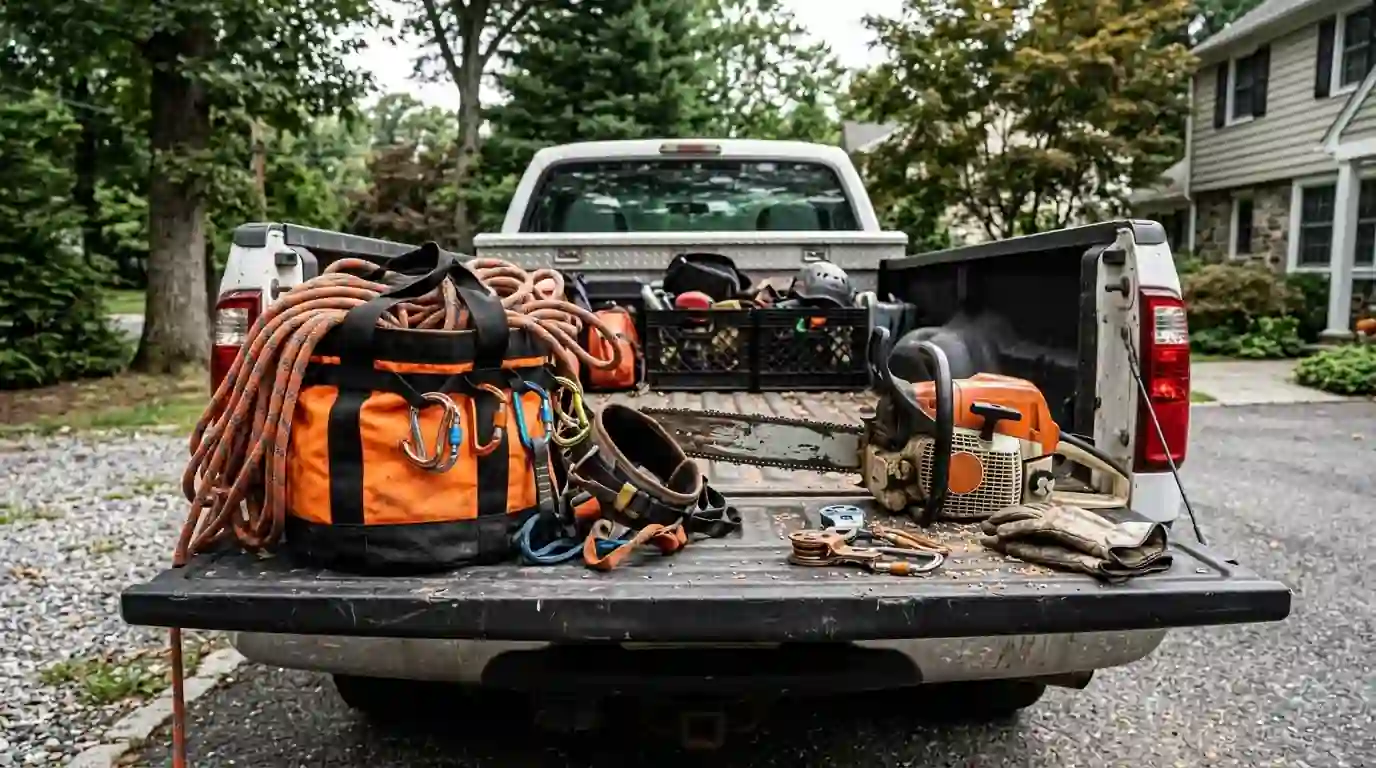
Philadelphia Street Tree Permits, Explained
Who owns the tree by your curb, what Parks and Recreation removes free, and when a contractor needs a city permit.
Tree Removal Permits in South Jersey Towns
What Cherry Hill, Haddonfield, Moorestown and Burlington Township ask before a tree comes down, and how to check your own town.
A Tree Fell in Philadelphia: Who Handles It?
Who handles a fallen tree in Philadelphia: 911, PECO, your cable company or you, plus a first-hour checklist.
Trees Near Power Lines: What PECO Does and What You Do
Who trims which wire in PECO territory, how a service drop make-safe works, and what to do when storms drop limbs.
Costs and planning a removal
Read these before you collect quotes. They lay out the published Philadelphia price ranges and what pushes a tree up or down within them, how a tree leaves a walled rowhome yard with no alley, and whether the stump should be ground or dug out once the tree is gone.
What Tree Removal Costs in Philadelphia, PA
Published Philadelphia tree removal ranges, the five factors behind a quote, and why rowhome yards and street trees change the price.
Taking a Tree Out of a Rowhome Yard With No Alley
How trees come out of walled rowhome yards: rope lowering, carrying through the house, crane picks and neighbor permissions.
Stump Grinding or Stump Removal: Which One?
Grinding versus full extraction: what each leaves behind, what each costs, and when the extra digging is worth it.
Invasive pests and the trees they ride on
Two invasions shape a lot of the tree work in this region. Emerald ash borer reached the Philadelphia area around 2012 and has been killing ash ever since, and spotted lanternfly arrived in the state in 2014 with a strong taste for tree of heaven. These guides cover when treatment is worth paying for and when the tree should simply go.
Save or Remove? Ash Trees After the Borer
How to spot emerald ash borer, what trunk injections cost, and when an ash should come down instead.
Why Cutting Tree of Heaven Is Not Enough
How to recognize tree of heaven, its link to spotted lanternfly, and why cutting without treatment brings it back.
Timing and warning signs
One guide is a pruning calendar for Delaware Valley trees, including the bloomers and oaks that break the winter rule. The other walks from the root flare up to the crown, listing the cracks, fungus and dieback that mean a tree should be looked at before the next storm instead of after it.
When to Trim Trees in Philadelphia
A month-by-month pruning calendar for Delaware Valley trees, plus the bloomers, fruit trees and oaks that break the winter rule.
Warning Signs a Tree Is Getting Ready to Fail
The base, trunk and crown signs that show a tree is weakening, plus local diseases and storm damage to watch for.
Questions
Questions about these tree tips
Wanda McBride, our Tree Advice Writer. She builds each guide from public sources such as city departments, utility guidance, state agriculture offices and extension services, and the questions callers ask most decide which topics come first.
No. They come from published cost surveys and are there to help you plan. We price every job after seeing the tree, the way in and out of the yard, and what sits underneath the canopy.
Each guide shows its update date under the byline. Local rules do change, as Burlington Township's 2024 tree chapter and New Jersey's 2026 invasive species law show, so confirm permit details with your town before work starts.
Yes, call and describe it. If it turns out to be work we do, we set a time to come and look; if it is something like a wire on the ground, we tell you who to call first.
Talk to us
Call about the tree, any hour
If a guide got you most of the way and you would rather have someone look at the tree itself, call us.
Call (916) 312-2373- Phone
- (916) 312-2373
- Hours
- Answered 24 hours a day, 7 days a week
- Office
- 578 Washington Ave, Burlington, NJ 08016