Quick answer
Save an ash only while its crown is still mostly full and it has no heavy dieback; a declining or dead ash should come down before it turns brittle. Treatment runs about $10 per inch of trunk diameter per injection, repeated every few years. Infested ash can die within three to four years, so the decision cannot wait long.
How the borer reached Delaware Valley yards
Emerald ash borer spread through Pennsylvania from Butler County, where it was found in 2007, and reached the Philadelphia area around 2012. Delaware County was among the last counties to be infested. New Jersey confirmed its first detection on May 21, 2014, in Bridgewater, Somerset County.
The damage happens out of sight. Larvae tunnel under the bark and cut off the tree's flow of water and nutrients. By the time the crown looks thin from the street, the trunk has usually been feeding larvae for a couple of seasons.
Is it even an ash, and is it infested?
Ash have branches and buds set in opposite pairs, compound leaves with roughly five to nine leaflets, and mature bark with tight, diamond-shaped ridges. Once you know it is an ash, look for these signs:
- Dieback starting at the top of the crown and working down.
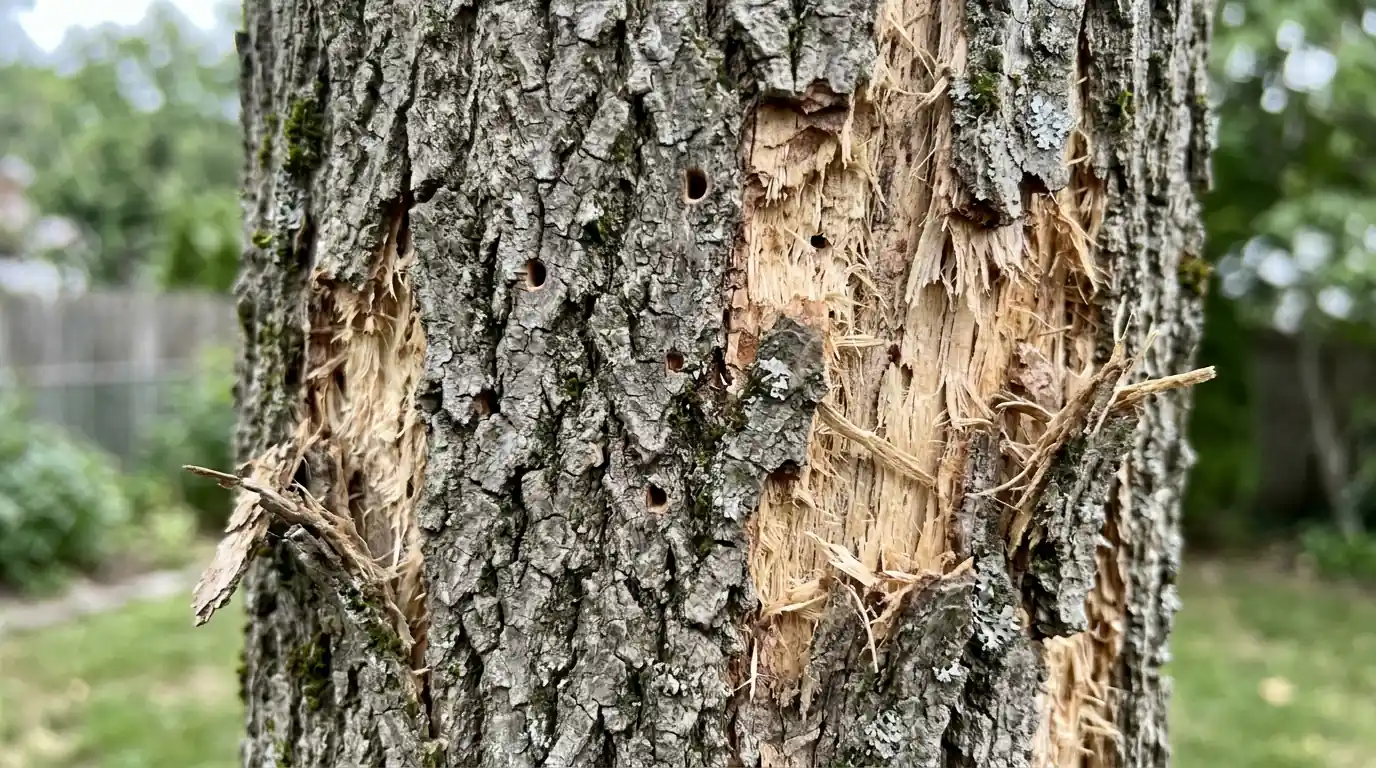
- Bark flaking off in patches, often where woodpeckers have been feeding on larvae.
- Small D-shaped exit holes in the bark, about the width of a pencil eraser.
- S-shaped tunnels under any loose bark.
- Bushy sprouts erupting low on the trunk or at the base.
- Thin vertical splits in the bark over larval galleries.
Why a dead ash is riskier than most dead trees
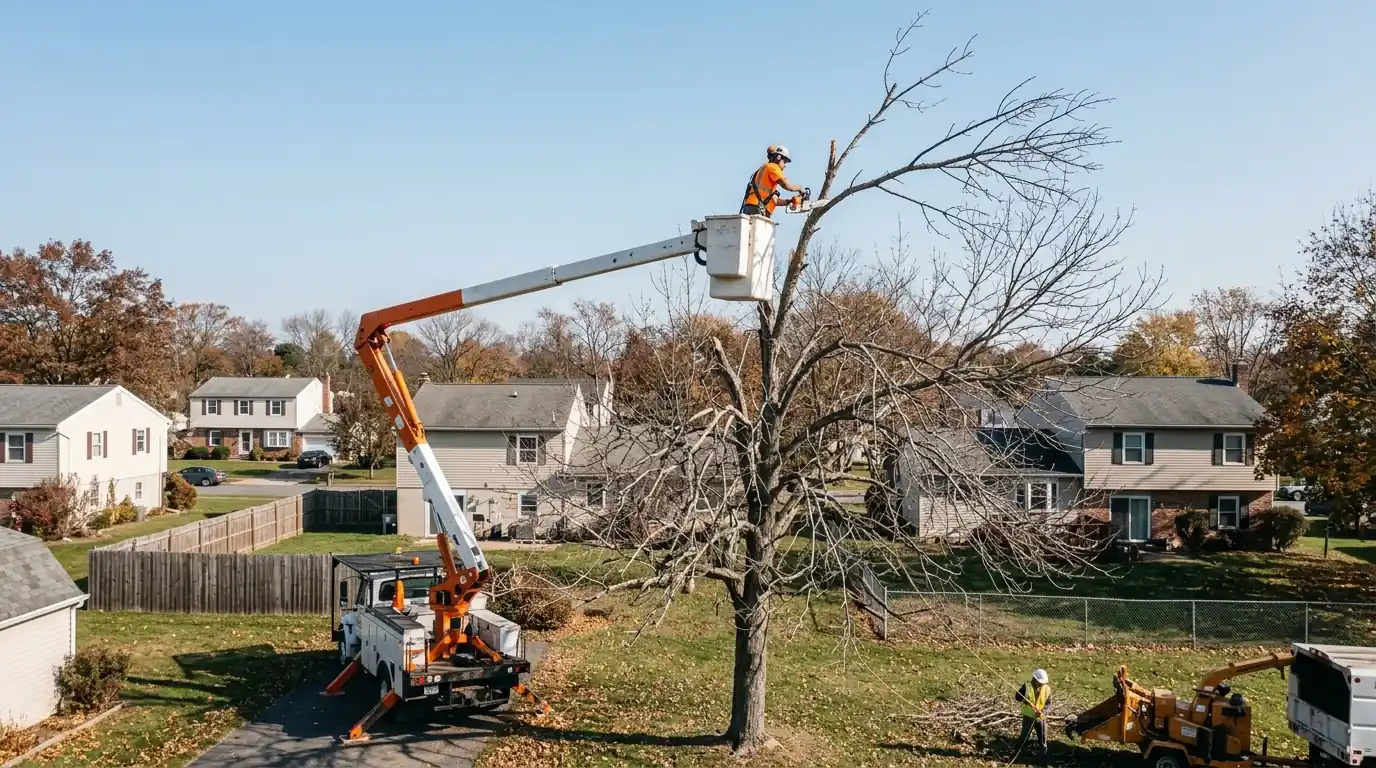
Ash wood dries and turns brittle quickly once the tree dies. Limbs that would bend on a dead oak snap on a dead ash, and the trunk can fail low without much warning. That makes climbing one a poor bet, so dead ash are often taken down from a lift or with a crane instead of by a climber on ropes.
The scale shows up in public land, too. Tyler Arboretum in Middletown Township, Delaware County, identified close to 900 hazardous ash, and its first removal phase of about 584 trees was expected to top $500,000. Our dead tree removal page explains how brittle trees come down, and crane-assisted removal covers the ones too far gone to climb.
What treatment costs and how it works
Protecting an ash means injecting a systemic insecticide into the trunk so the tree carries it up through the canopy. A Purdue Landscape Report example puts the cost at about $10 per diameter inch, roughly $300 per injection cycle for a 30-inch ash, repeated every 3 years. General tree injection is listed by HomeAdvisor at $50 to $200 per tree, so smaller trunks sit well below that example.
Treatment protects a tree that still has the canopy to move the product around. It cannot regrow a dead top. On our ash borer injection visits we measure the trunk, look at the crown, and say plainly when a tree is past saving.
Not sure if your ash is worth saving? Call and we will look at the crown with you.
Call (916) 312-2373Save or remove: a simple way to decide
Use the crown as your guide, then weigh what the tree would hit if it failed.
| What you see | Lean toward | Why |
|---|---|---|
| Full crown, no exit holes, healthy color | Treat | The tree can still move insecticide through its whole canopy |
| Light thinning at the top, a few exit holes | Treat soon, then watch | Early infestation can often be held if injection starts now |
| Half or more of the crown bare | Remove | Too much of the canopy is gone for treatment to bring it back |
| Dead, with bark sloughing off | Remove promptly | Wood is turning brittle and gets harder to take down each season |
| Any decline over a house, wire or sidewalk | Lean toward removal | A failure there costs far more than the tree is worth |
Running the numbers over ten years
A healthy 30-inch ash on a three-year injection cycle needs three or four treatments in a decade. Set that beside a one-time removal: HomeAdvisor lists medium trees of 30 to 60 feet at $450 to $1,200 and large trees of 60 to 80 feet at $800 to $1,500. Stump grinding is extra.
If the tree shades the house, frames the yard and is in good shape, treatment is often worth it. If it is already thinning, removal now is cheaper than removal later, when the wood is brittle and a lift or crane is the only safe way up. Planned ash tree removal on a calm day beats an emergency call after a limb lands on the roof.
Timing, and why waiting raises the stakes
Pennsylvania observations put the death of an infested ash at three to four years, and New Jersey's agriculture department says three to five years after infestation begins. Either way, the window between noticing and losing the tree is short.
If you cannot tell which column of the table your tree falls in, a tree risk inspection settles it. For other symptoms that point to a failing tree, see our guide to warning signs in the crown and trunk.
Ash tree questions
Once about half the crown is bare, treatment rarely brings it back. Injection works through the living canopy, so a tree with a full or lightly thinned crown is the one worth injecting.
The Purdue example uses a cycle repeated every 3 years. Treatment has to continue for as long as you want to keep the tree, because the borer remains in the region.
Homeowner soil products are labeled for smaller trees and work slowly through the roots. For a large ash over a house, trunk injection puts the product into the tree directly and is easier to time.
No. Each tree is protected only by the product inside it. An untreated ash beside a treated one can still be infested and die, and then becomes a hazard of its own.
Yes, burning it close to home is fine once it is seasoned. Avoid hauling ash firewood to other counties or a campground, since moving firewood is one way the borer spreads.
Ash work we handle
Ash Tree Removal
Ash trees killed or failing from emerald ash borer, removed before they shed.
Emerald Ash Borer Treatment
Trunk injections that protect healthy ash worth saving from the borer.
Dead Tree Removal
Brittle dead wood taken down from a lift or by rope instead of climbing it.
Tree Inspection & Risk Assessment
A walk-around look at decay, cracks, lean and roots, with a straight answer on what needs doing.
Have an ash you are unsure about?
Call and tell us what you see in the crown. We will look at it and give you an honest save or remove answer.