Quick answer
Published data puts most Philadelphia tree removals between $500 and $2,200 per tree, and HomeBlue puts the city average near $1,400. National HomeAdvisor figures run lower, $200 to $2,000. The gap comes from access: rowhome yards, sidewalk trees and tight streets add labor hours, and a three-person crew in the city is quoted at $240 to $310 per hour.
Published price ranges, side by side
These are planning numbers from cost surveys, not anyone's quote. They help you tell whether a price is in the normal band or far outside it. Height ranges come from national data, so read them as a floor for city work rather than a ceiling.
| Job | Published range | Source and basis |
|---|---|---|
| Tree removal, Philadelphia | $500 to $2,200 | HomeBlue, city data, average near $1,400; stump usually extra |
| Tree removal, national | $200 to $2,000 | HomeAdvisor, average $750 per tree |
| Small tree, up to 30 ft | $150 to $450 | HomeAdvisor, national, by height |
| Medium tree, 30 to 60 ft | $450 to $1,200 | HomeAdvisor, national, by height |
| Large tree, 60 to 80 ft | $800 to $1,500 | HomeAdvisor, national, by height |
| Very large tree, over 80 ft | $1,000 to $2,000 | HomeAdvisor, national, by height |
| Emergency removal | as high as $5,000 | HomeAdvisor, national upper figure |
| Crane line item | $250 to $600 per day | HomeAdvisor; complex crane jobs can reach $6,000 to $7,000 |
| Stump grinding | $120 to $500 | HomeAdvisor, average $250; single-stump minimums $100 to $150 |
| Three-person crew, Philadelphia | $240 to $310 per hour | HomeBlue, city hourly rate |
Notice that the city range starts where the national one is still in its middle. That is not a markup for the zip code. It is the extra hours city lots demand, which the hourly crew rate makes easy to picture.
Five things that decide where one tree lands
Two 50-foot maples can be priced hundreds of dollars apart, and both quotes can be fair. Here is what an estimator is actually adding up while walking around the trunk.
- Height and spread, because every extra limb is another cut, another rope and another trip to the chipper.
- Targets under the canopy: slate roofs, porches, cars and fences mean smaller pieces lowered slowly instead of dropped.
- The wood route, from a short drag to the street up to hand-carrying every round through a narrow passage.
- Wires and paperwork, such as a utility make-safe on the service drop or a city permit for a street tree.
- Cleanup scope: chips left or hauled, logs split for firewood, and whether the stump is ground.
Why rowhome yards cost more to clear
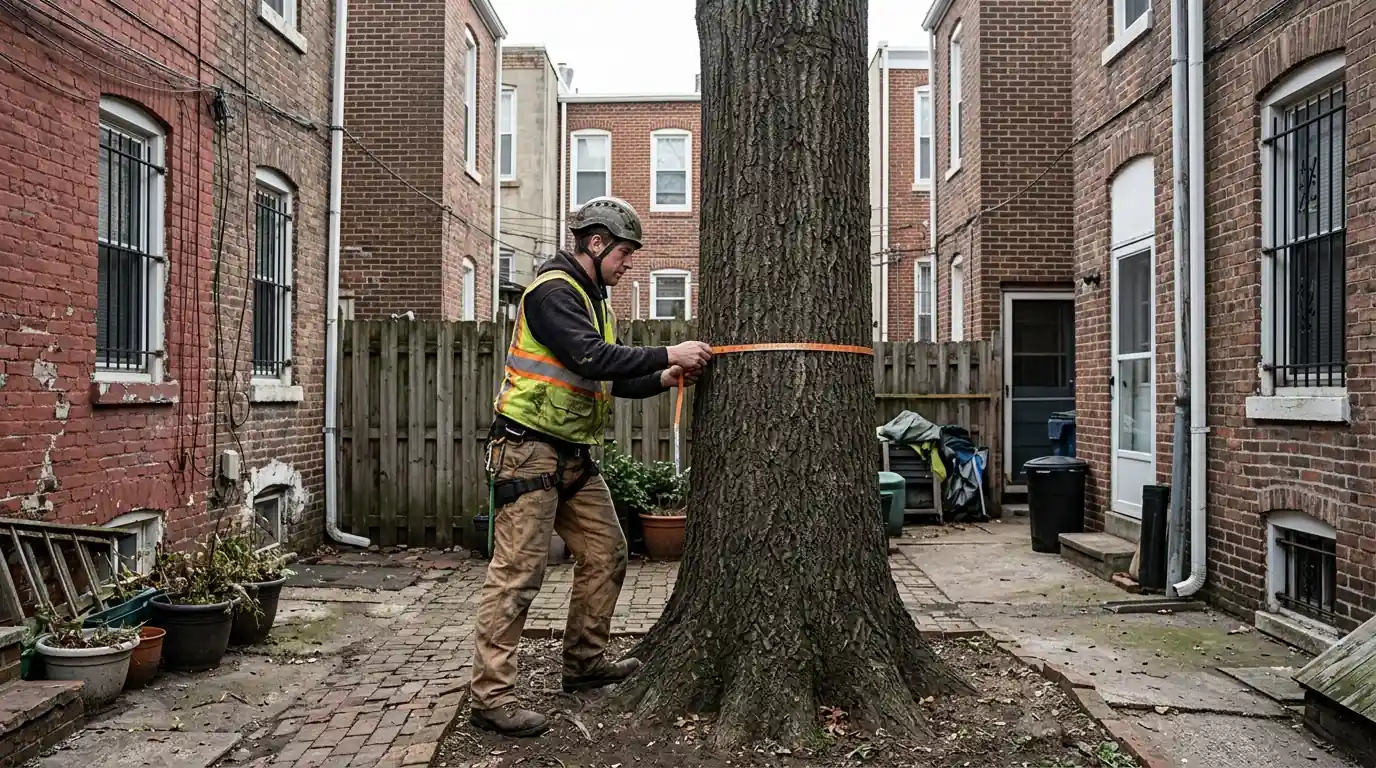
Rowhomes make up about 70 percent of Philadelphia's housing, and many backyards behind them have no alley or side gate. A tree there cannot be dropped and no chipper can reach it. Every limb is cut small enough for one person to carry, and every log leaves through the house on protected floors or over the roof on a crane.
Put that against the hourly rate. If carrying adds four hours, a crew billed at $240 to $310 per hour has added real money before a single extra cut. Our page on clearing a yard with no alley explains how those jobs run, and the rowhome yard guide covers the planning from your side.
Not sure which band your tree falls in? Call and describe it, and we will tell you what drives the price.
Call (916) 312-2373Street trees: sometimes the city pays
A tree in the sidewalk strip sits in the public right-of-way. You own it, but Parks and Recreation manages it, and that changes the money. Parks and Recreation removes dead or hazardous street trees at no charge, so a clearly dead tree out front may cost you only patience.
A healthy, living street tree is different: the city will not take it down. If you want it gone, or want a dead one handled sooner, you pay a contractor, and that contractor needs a tree work permit from Parks and Recreation Street Tree Management first. Permit time belongs in your schedule. The street tree removal page and the street tree permit guide walk through it.
When a crane shows up on the estimate
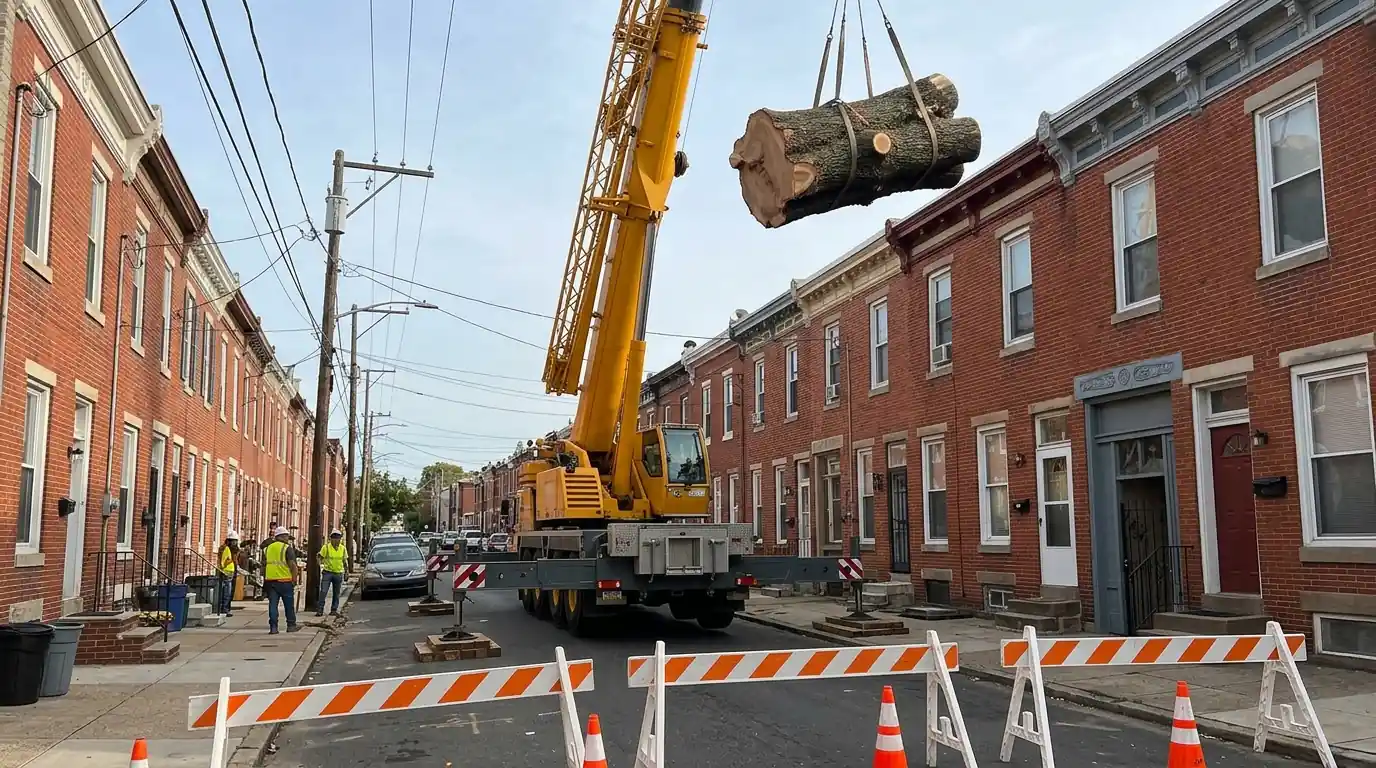
A crane gets priced in when a tree is too tall, too rotten or too boxed in to climb and lower safely. HomeAdvisor lists the crane itself at $250 to $600 per day for trees over about 80 feet, while complex crane jobs can reach $6,000 to $7,000 in total.
In Philadelphia a crane parked on the street also needs a street closure permit through the Streets Department. That is a separate filing from any tree permit, and it sets the date more than the weather does. If your estimate includes a crane pick over the house, ask who files for the closure.
Stumps, wood and the lines that get added later
Most published removal figures leave the stump out. Grinding is listed separately at $120 to $500. Single-stump minimums of $100 to $150 are common, so a small stump can cost close to a large one. Decide before the day whether you want the stump ground out or left for later.
Wood is the other swing item. Keeping logs for firewood shortens the haul, while hauling every chip and round adds trips. A limb on the overhead service line is a third: PECO will make the drop safe so work can go ahead, but it asks for about two weeks' notice.
What emergency pricing really buys
HomeAdvisor notes emergency removals can run as high as $5,000. Part of that is the hour, but most of it is the situation: a trunk resting on a roof is under load, so rigging it off without more damage is slow, careful work that an upright tree would not need.
The least costly emergency is the one you head off. A tree with a dead top, a fresh crack or a new lean costs far less to take down on a calm weekday. If you are unsure, a risk inspection tells you whether it can wait.
Tree removal pricing questions
Usually the plans differ. One estimator may count on dropping limbs while another plans to lower every piece over a roof, or one includes stump grinding and hauling while the other leaves them out. Compare scope line by line.
If it is a street tree that is dead or hazardous, Parks and Recreation removes it at no charge. A healthy street tree stays unless you hire a contractor, who must get a Parks and Recreation permit first.
A fixed per-tree price protects you on jobs where surprises are likely, like hidden rot. Hourly billing can come out lower on simple work with good access. Either way, ask what is included.
There is no published winter discount. Dormant season can help, though: bare limbs are lighter, and frozen ground carries heavy wood with less lawn damage, which can shorten the day.
Policies typically help when a tree falls on a covered structure, and rarely for taking down a standing tree you simply want gone. Read your own policy or ask your agent before the work.
Getting the grinder there, setting up and cleaning up take about the same time for any stump. That is why HomeAdvisor reports single-stump minimums of $100 to $150.
Removal work this guide prices
Tree Removal
Sectional takedowns sized to the yard, with the wood, brush and cleanup handled.
Tight-Access Backyard Tree Removal
Rowhome and twin yards with no alley, worked by rope and by hand.
Crane Tree Removal
Big picks lifted over roofs when there is no safe way to lower the wood by rope.
Stump Grinding
Stumps ground below grade, the chips raked out or left as mulch.
Want a real number for your tree?
Call and describe the tree and the yard. We will come look and give you a price before any cutting starts.