Quick answer
The clearest signs a tree may fail are mushrooms or conks at the base, soil heaving on one side, cracks or cavities in the trunk, a new lean, and dead or thinning branches in the crown. One sign calls for a closer look; several together, or any of them over a house or walkway, mean it should be inspected soon.
Start at the base and the roots
Root problems cause some of the most sudden failures, because a tree with a rotten root plate can look healthy above ground right up until it tips over. Walk around the trunk and look low. Thick ivy can hide cracks and cavities, so stripping vines off the trunk often has to come before anyone can judge the wood.
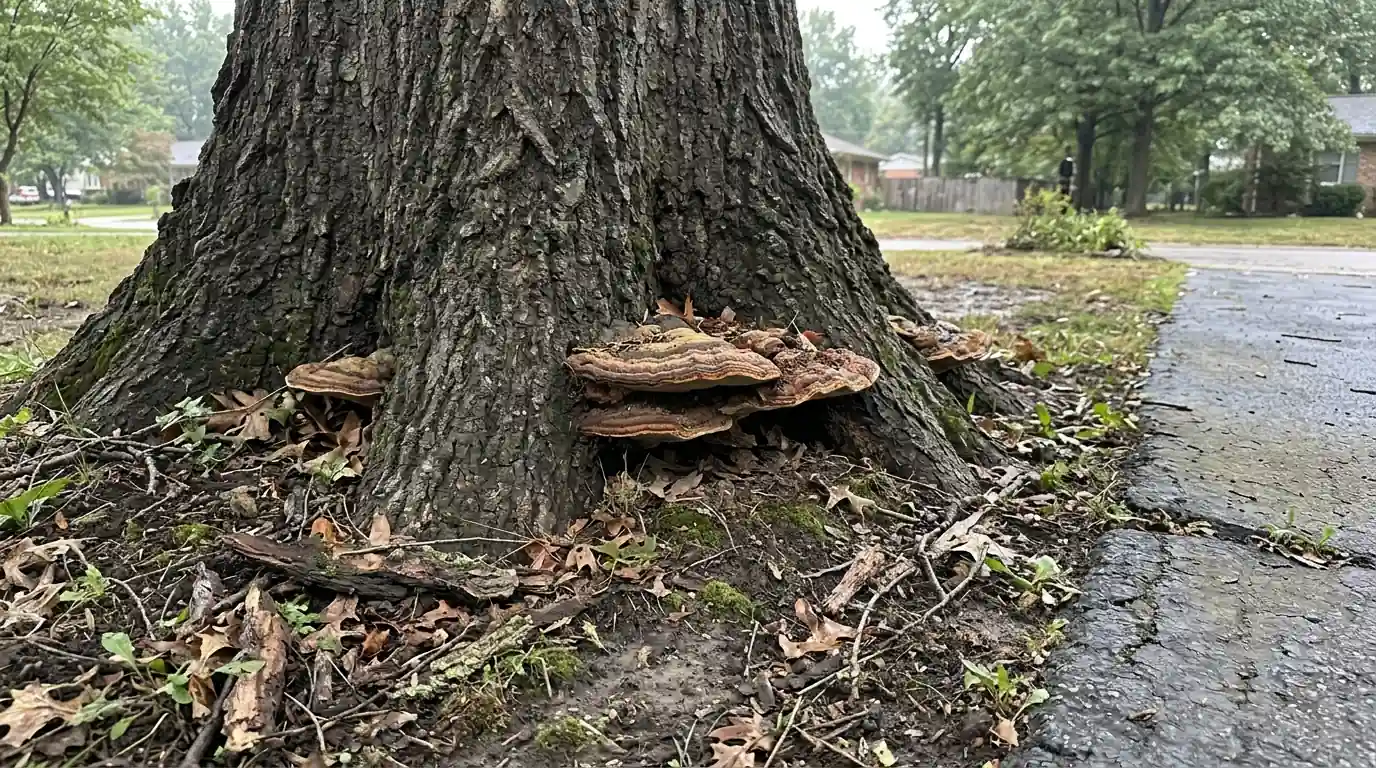
- Mushrooms, shelf-like conks or soft, punky wood at the root flare.
- Soil cracked, mounded or lifted on one side, often the side away from the lean.
- Roots cut for a sidewalk, driveway, utility trench or addition in the last few years.
- A trunk that goes straight into the ground like a pole, with no visible flare, which can hide girdling roots.
- Cavities or open wounds at ground level where rot can enter.
Read the trunk for cracks and hollows
The trunk carries the whole weight of the crown, and defects there tend to get worse with each windy season.
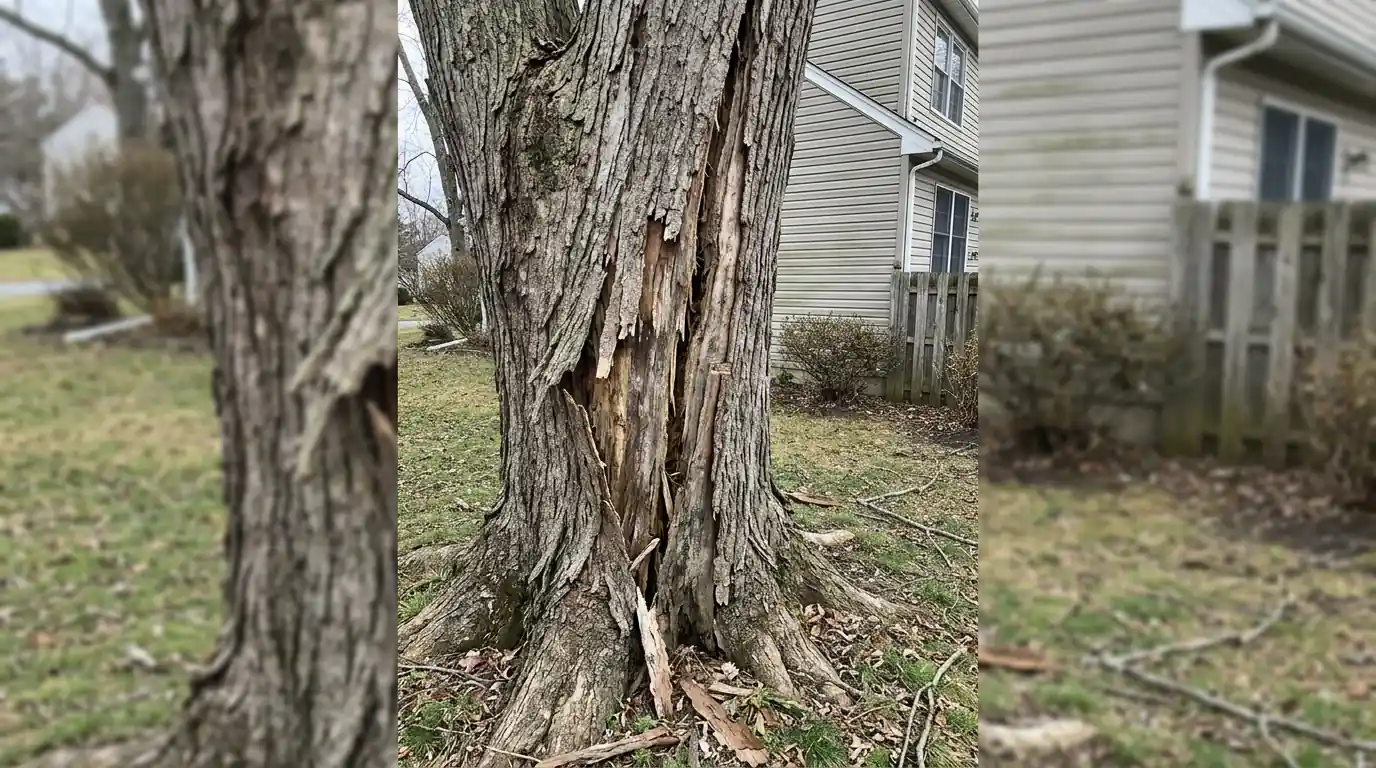
Look for vertical cracks or long seams, especially ones that open and close as the tree sways. A tight V-shaped fork with bark pinched between the two stems is a weak union that often splits in storms. Cavities, oozing wounds, sections of missing bark and sawdust from carpenter ants are all signs of decay inside. A small hollow in a thick trunk can be fine; a large one in a thin shell is not.
A weak fork caught early can sometimes be supported with cables and braces instead of removing the tree.
Look up into the crown
The crown is where decline shows first, often a year or two before anything else. Compare the tree with its neighbors of the same species.
- Dead branches with no bark or leaves, especially large ones over the roof or drive.
- Broken limbs hung up in other branches, waiting for the next gust.
- A thin crown with smaller leaves than the tree had a few years ago.
- Dieback starting at the very top and moving down.
- Early fall color or leaf drop in mid-summer.
Scattered deadwood in an otherwise full crown is routine work: deadwood removal takes it out before it falls. Broken hangers are more urgent, and our hanging limb removal page explains how they come down.
Spotted one of these on a tree near your house? Call and describe it, and we will tell you how soon to act.
Call (916) 312-2373Diseases moving through local trees
Three problems account for a lot of decline across the region. Beech leaf disease reached Pennsylvania in 2016 and was in 65 of 67 counties, Philadelphia included, by 2022, while New Jersey found it in 12 of 21 counties by September 2022. Dark bands between the leaf veins come first, then crown thinning and branch dieback.
In New Jersey oaks, bacterial leaf scorch browns leaf edges from mid-summer to early fall, and branches die back over several years until the tree dies. There is no cure, and the NJ Forest Service advises pruning well below affected leaves. Emerald ash borer, meanwhile, kills infested ash within three to four years, with a dying upper crown, flaking bark and D-shaped exit holes. Our guide to ash trees and the borer covers that choice in detail.
What changes after a storm
Storms test every weakness at once. When Ida's remnants passed through in September 2021, they produced seven tornadoes in the region, including an EF-2 from Fort Washington and Upper Dublin into Horsham and an EF-1 that crossed the Delaware from Edgewater Park to Bristol. Trees that survived storms like that can carry damage that only shows later.
After high winds, check for a lean that was not there before, soil lifted around the root plate, fresh cracks in the trunk and limbs hanging in the canopy. A tree that shifted during a storm and has not settled needs attention right away, and leaning tree removal is often the safe answer for one leaning toward a house.
How urgent is what you found?
Not every sign means a tree has to come down. Use this as a rough guide, and remember that the same defect is more serious over a bedroom than over a back fence.
| What you see | How urgent | Usual next step |
|---|---|---|
| A few small dead branches | Low | Prune at the next convenient time |
| Mushrooms or conks at the base | Moderate to high | Have the root flare and decay checked |
| Crack or split in the main trunk | High | Keep people clear and have it inspected soon |
| New lean with soil heaved | Urgent | Call right away; removal is often needed |
| Large hanger over a roof or walkway | Urgent | Keep the area clear and have it brought down |
When you are not sure, a tree risk inspection puts a trained eye on the defect and tells you whether to prune, support, watch or remove.
Questions about failing trees
Often they do. Mushrooms and conks are the fruiting bodies of fungi that feed on wood, and at the root flare they can point to decay in the roots or lower trunk. It needs a closer look, not panic.
Yes. Root rot and decay inside the trunk can leave a full, green crown for years. That is why the base and the soil around it matter as much as the leaves.
No. Trees wall off decay, and a thick shell of sound wood around a hollow can hold up well. The risk depends on how thick that shell is compared with the trunk, and what the tree would hit.
An old lean usually has a trunk that curves back upward toward the light. A new one is straight from the ground, often with cracked or mounded soil on the side opposite the lean.
If the tree is close to the house or swayed hard, yes. Storms can loosen roots, start cracks and leave limbs hung up without anything visibly hitting the ground.
Look for dark bands between the leaf veins, easiest to see from below against the light. Later the crown thins and branches die back. It has been found across both Pennsylvania and New Jersey.
Help for a tree that worries you
Tree Inspection & Risk Assessment
A walk-around look at decay, cracks, lean and roots, with a straight answer on what needs doing.
Leaning Tree Removal
A tree that shifted in the last storm, checked at the root plate and taken down under control.
Deadwood Removal
Dead branches cut out of the crown before they drop on someone.
Tree Cabling & Bracing
Steel cables and rods that support weak unions in trees worth keeping.
Worried about a tree on your property?
Call and tell us what you are seeing. We will come look and explain whether it needs pruning, support or removal.