Quick answer
It depends on the town. Cherry Hill needs a permit for most trees 5 inches or more across, Burlington Township covers trees from 6 inches on private land, and Haddonfield and Moorestown control the trees in the strip by the street. Rules change, so call your municipality before any cut, even for a tree that is dead.
Why the answer changes at every town line
New Jersey leaves most tree rules to municipalities, so there is no single state permit for removing a backyard tree. Each township or borough decides which trees it covers, what size triggers a permit, whether there is a fee, and whether you owe a replacement.
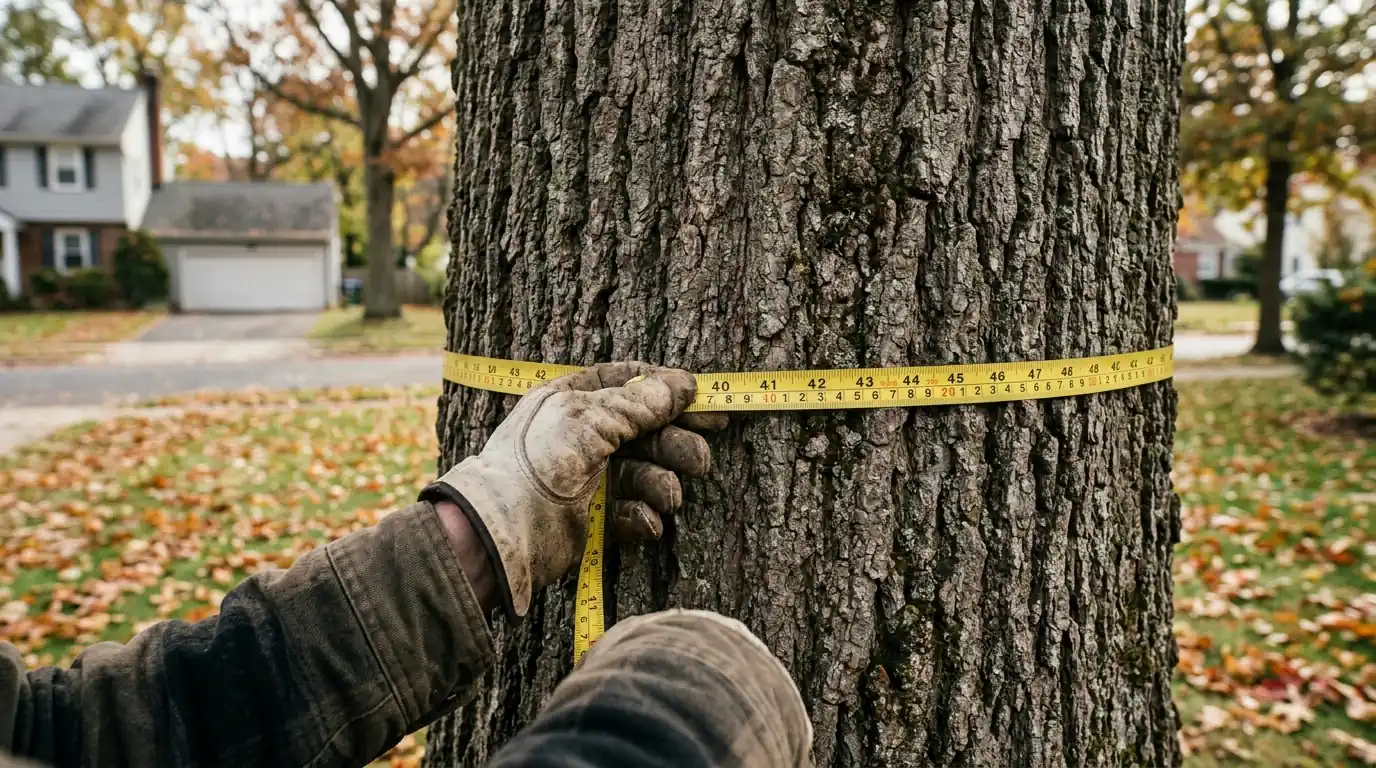
Two questions sort out most cases. First, is the tree in the strip between sidewalk and street, or on your own lot? Many towns treat the curb strip as public, even though it sits in front of your house. Second, how big is the trunk? Thresholds are written as diameter at breast height, measured about four and a half feet off the ground, so a quick tape around the trunk tells you where you stand.
Cherry Hill: permits for most trees 5 inches and up
Cherry Hill Township's rule reaches more trees than many owners expect. A permit is required to remove, or to trim more than 30 percent of, any tree 5 inches or more in diameter at breast height. That applies whether the tree is healthy or dead.
- Residential permits carry no fee
- Any number of dead trees can go on a residential permit
- Up to three healthy trees per 12 months
- Each extra healthy tree needs a one-for-one replacement or a $175 payment to the Cherry Hill Tree Fund
- Invasive species, routine pruning and trees posing an imminent threat are exempt, after checking with Public Works
That last point matters: exempt does not mean skip the phone call. Check with Public Works first, then schedule the work. If you live there, our Cherry Hill tree service page covers the kinds of jobs we see in the township.
Haddonfield and Moorestown: hands off the curb-strip trees
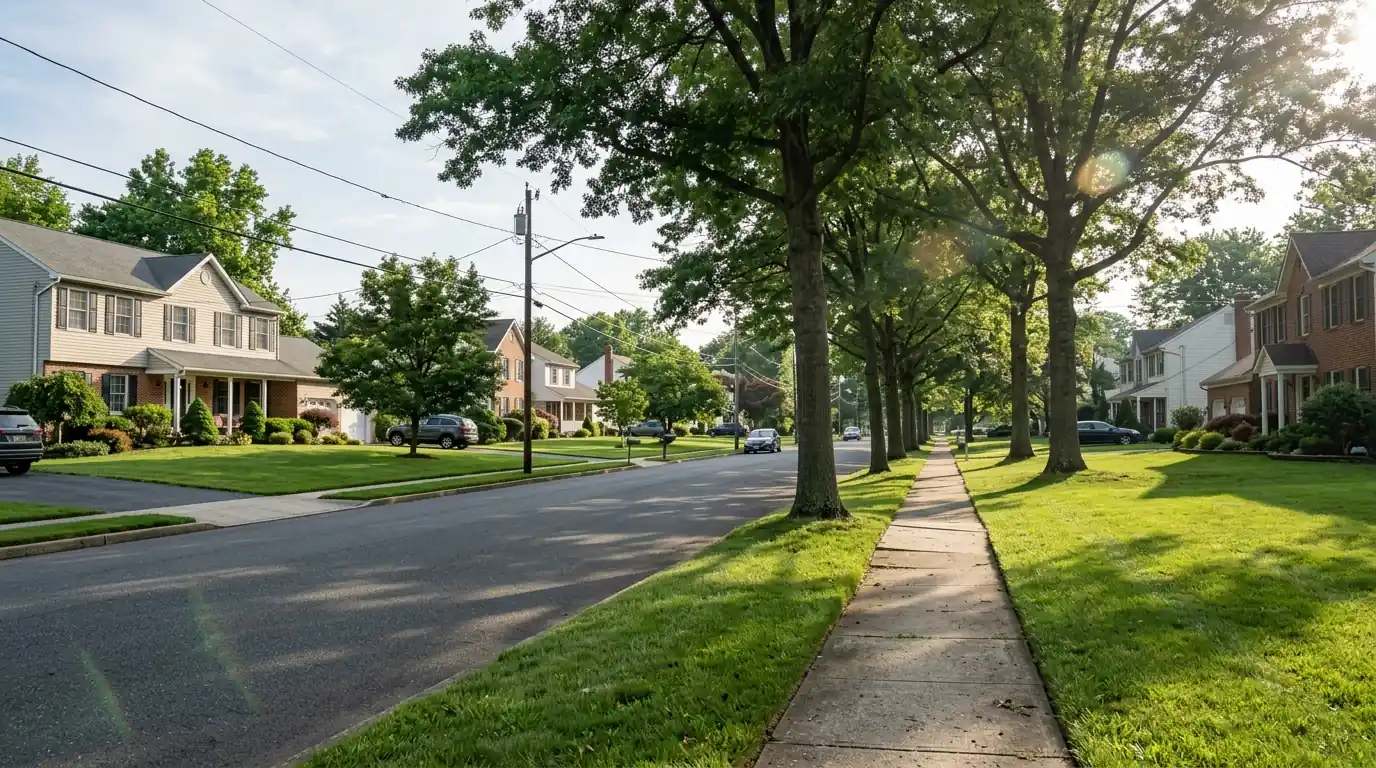
Haddonfield Borough maintains about 9,000 trees along its streets and public areas, including the park strip between street and sidewalk. Residents may not prune a Borough tree without written permission from the Superintendent of Public Works. Dead or storm-damaged Borough trees are generally removed in winter, and their stumps are sometimes left in place for a year or more.
Moorestown works along similar lines. Under a 2018 ordinance, trees in the right-of-way strip between sidewalk and road are township trees, more than 6,200 of them. An owner who wants to remove, trim or otherwise disturb one needs a permit from the Department of Public Works, or faces fines, fees and replacement costs. Our Moorestown page has more on working in the township.
In both towns, the rules described here are about public trees. For a tree well inside your own yard, ask the municipality directly what applies; do not assume either way. If the tree in question is in the curb strip, the job runs like our street tree removal work: the town's sign-off comes before any saw.
Not sure whether your tree needs a permit? Call and tell us the town and the tree.
Call (916) 312-2373Burlington Township: the 2024 tree removal chapter
Burlington Township adopted a tree removal and replacement chapter on April 23, 2024. This is the township, a separate municipality from the City of Burlington, so check which one your address falls in. Street trees 2.5 inches or larger need the township to look at them before work, and trees on other land are covered from 6 inches up.
There is a homeowner exemption: residents removing fewer than four trees per acre in five years are exempt. Beyond that, the fee is $100, and replacements scale from one to four trees depending on trunk size, or $50 to $250 per tree paid in lieu. Hazard trees flagged by Public Works carry no fee and no replacement, so if a tree is failing, ask the township to look at it before you budget for the full cost.
The four towns side by side
This summary is for orientation only. Ordinances get amended, and the town's own office has the final word.
| Town | Which trees | Cost or replacement | Who to ask |
|---|---|---|---|
| Cherry Hill | Any tree 5 inches DBH or more, healthy or dead; also trimming over 30 percent | No residential fee; beyond three healthy trees a year, replace one-for-one or pay $175 | Public Works |
| Haddonfield | Borough trees on streets and the park strip | Written permission needed even to prune | Superintendent of Public Works |
| Moorestown | Township trees in the strip between sidewalk and road | Fines, fees and replacement costs without a permit | Department of Public Works |
| Burlington Township | Street trees from 2.5 inches; other trees from 6 inches | $100 fee; one to four replacements or $50 to $250 per tree; small homeowner removals exempt | Public Works for hazard trees |
Bradford pears and New Jersey's 2026 invasive species law
In January 2026 New Jersey enacted its Invasive Species Management Act. It bars selling, distributing or propagating listed invasive plants without a state permit, carries penalties up to $5,000 for repeat violations, and names Callery pear, the tree most people know as Bradford pear, on its list.
The law targets the trade in these plants rather than the trees already in your yard. Still, it is a fair signal that a Bradford pear is worth replacing rather than nursing along, especially after it splits in a storm. In Cherry Hill, invasive species fall under the permit exemption once Public Works confirms, which can make taking out a Bradford pear simpler than removing a healthy native. When you choose what goes in its place, skip anything on the state list; our replacement tree planting page covers picking a tree for the spot.
How to check the rules in your own town
Most South Jersey towns have something on the books, and the details are rarely posted where you would look first. Before a removal, call the municipal building and ask for Public Works, the shade tree commission or the code office.
- Does the town regulate trees on private lots, or only street and public trees?
- What trunk size triggers a permit, and is it measured at breast height?
- Is there a fee, and is a replacement tree or payment required?
- Are dead, hazardous or invasive trees exempt, and who has to confirm that?
- How long does approval usually take, and does the permit need to be posted?
Write down who you spoke with and when. If a permit is needed, we can factor it into the schedule for your tree removal, and for larger jobs, such as clearing part of a wooded lot, the tree count rules matter even more.
South Jersey permit questions
Yes. Cherry Hill's permit covers trees 5 inches or more across whether healthy or dead. Residential permits carry no fee and allow any number of dead trees, so the step is mostly paperwork.
Not without written permission from the Superintendent of Public Works. The Borough maintains the trees in that park strip, so ask them before cutting any branch, even a small one over your walk.
Under the 2018 ordinance, removing, trimming or disturbing a tree in the strip between sidewalk and road without a permit can bring fines, fees and replacement costs. Ask the Department of Public Works first.
No. They are separate municipalities. The rules described here come from Burlington Township's 2024 chapter. If your address is in the City of Burlington, check with the city's own offices.
That depends on your town. The 2026 state law targets selling and spreading Callery pear, not removal. Cherry Hill exempts invasive species after a check with Public Works; other towns set their own terms.
Tree work that often needs a town sign-off
Tree Removal
Sectional takedowns sized to the yard, with the wood, brush and cleanup handled.
Street Tree Removal
Sidewalk-strip trees, with the Parks and Recreation permit step sorted before any cut.
Bradford Pear Removal
Callery pears that split in wind and spread across yards, taken out at the root.
Tree Planting
Planting replacement trees, including the replacements some towns require.
Have a South Jersey tree to take down?
Call and tell us the town and the tree. We will talk through the permit question with you and plan the removal around the town's answer.